
Introduction
Artificial intelligence has transformed nearly every corner of digital life, from writing tools to image generators. But not every use of this technology is positive. One of the most troubling developments in recent years is the rise of the AI nudifier — a type of software that uses machine learning to digitally remove clothing from photos of real people, creating fake nude images that were never taken.
These tools, also called “deepfake undressers” or “nudify apps,” have grown far more sophisticated and accessible since their earliest versions appeared around 2018. What was once a fringe concern is now a mainstream safety crisis, affecting teenagers, celebrities, professionals, and everyday people around the world.
Understanding how these tools work — and why they’re so harmful — is essential for anyone who uses the internet in 2025.
What Is an AI Nudifier and How Does It Work?
An AI nudifier is a software application powered by Generative Adversarial Networks (GANs), a type of deep learning technology. GANs work by pitting two computer systems against each other: one generates fake images, while the other evaluates whether they look real. Over time, through repeated cycles of generation and evaluation, the outputs become increasingly convincing.
When a photo is uploaded to a nudifier tool, the AI analyzes the shapes, skin tones, proportions, and textures in the image and attempts to predict what the person might look like without clothing. It fills in fabricated details using patterns learned from vast datasets of real images.
The result is a synthetic image — not a real photograph — but one that can look disturbingly realistic, making it very difficult for most people to detect as fake at first glance.
Who Is Being Harmed?
The impact of AI nudifiers is not abstract. Real people — including minors — have been targeted.
High-profile cases that made global headlines include:
- In January 2024, AI-generated explicit images of pop star Taylor Swift spread rapidly across major social media platforms, receiving millions of views before being removed. The incident exposed how quickly this content can go viral.
- In 2024, a 14-year-old Texas girl named Elliston Berry discovered that AI-generated nude images of herself were being shared among classmates. The experience caused severe anxiety and social isolation.
- Across California and other US states, similar cases involving school-aged children prompted urgent legislative action.
Research shows that over 99% of nudified content depicts women, and girls are particularly at risk. Kidslox Even though these images are fabricated, they can cause shame, humiliation, bullying, anxiety, and long-term emotional distress. Once shared, they can be nearly impossible to fully remove. Kidslox
A 2025 Digital Ethics Coalition report found that 78% of victims experience significant mental health impacts. Keepnet Labs
The Legal Landscape: Crackdowns Are Accelerating
Governments around the world are moving quickly to criminalize the creation and distribution of AI-generated non-consensual explicit images.
Key legal developments in 2025:
- The TAKE IT DOWN Act, a US federal bipartisan initiative to prohibit unauthorized explicit images from being shared on social media, was signed into law by President Trump in May 2025. Elliptic
- Florida enacted a sweeping new law that took effect on October 1, 2025, making it illegal to produce sexual images of a person using AI or similar technologies without their permission. WUSF
- In the UK, sharing non-consensual intimate images — whether real or AI-generated — is a criminal offense under the Online Safety Act 2023, and platforms are legally required to remove such content. Kidslox
- The EU’s AI Act targets deepfakes with fines of up to €30 million, requiring platforms to label AI-generated content and offer reporting tools. Keepnet Labs
- As of 2024, 30 US states had enacted or proposed legislation to outlaw explicit deepfake generation. Elliptic
The message from lawmakers globally is clear: creating, sharing, or even possessing AI-generated nude images of real people — especially minors — can result in criminal prosecution.
Why These Tools Are Almost Always Scams Too
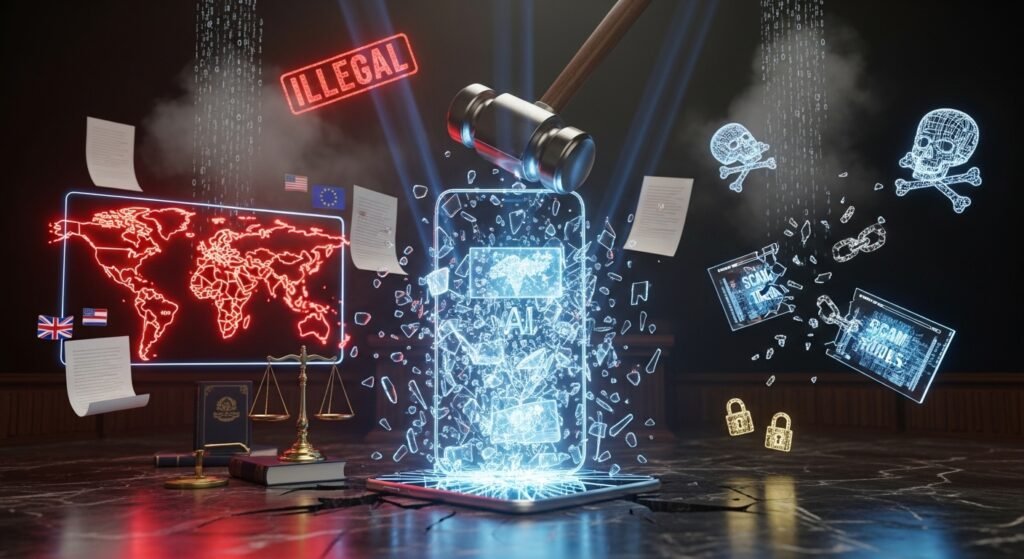
Beyond the ethical and legal dangers, AI nudifier websites and apps present serious cybersecurity risks to users who attempt to access them.
- Data theft — uploaded photos are often harvested and stored without consent
- Malware — many sites install malicious software on the user’s device
- Phishing and extortion — users who upload photos of themselves or others become easy targets for blackmail
- Financial fraud — fake premium plans collect payment details and disappear
In 2024, executives faced deepfake extortion scams demanding cryptocurrency, with AI-generated imagery used as leverage. Keepnet Labs This type of crime, known as sextortion, is growing rapidly.
How Platforms and Tech Companies Are Responding
Major technology platforms are not sitting still. Several significant steps have been taken to detect and remove this content automatically.
- Meta banned AI-generated nudity outright across its platforms in 2024.
- Telegram removed some of the most popular nudifier bots from its platform following public pressure and legal scrutiny.
- Digital platforms now deploy auto-detection systems that analyze image metadata and pixel manipulation patterns to identify and remove deepfake content before it spreads. Make An App Like
- AI detection tools, such as those developed by Sensity, now achieve approximately 90% accuracy in identifying synthetic nude imagery.
Despite these advances, enforcement remains a challenge. Many nudifier services operate from offshore servers specifically to evade national laws, and new tools continue to appear faster than regulators can shut them down.
Protecting Yourself: Practical Steps
Whether you’re concerned about your own photos, a child’s safety, or a colleague’s digital wellbeing, here are actionable steps to take:
To protect yourself:
- Audit your social media privacy settings regularly and restrict who can access your photos
- Never share high-resolution images of yourself in public-facing spaces without understanding the risks
- Use reverse image search tools to check if your photos are being used without your knowledge
- Report suspicious content immediately on any platform where you encounter it
If you’re a victim:
- Document everything — screenshot URLs and content before reporting
- Report to your national cybercrime authority (in the US, this is the FBI’s IC3 or the NCMEC CyberTipline)
- Contact platforms directly to request emergency content removal
- Seek legal advice — new laws in many countries now offer strong civil and criminal remedies
For parents and educators:
- Talk openly with young people about AI image manipulation before they encounter it
- Use parental control tools to limit access to unknown or unverified apps
- Explain that experimenting with nudify tools can have serious legal consequences — children and teenagers may not understand this risk. Kidslox
The Ethical Bottom Line
A 2024 Pew Research study found 73% of adults oppose AI-generated nudity without the subject’s permission. ReelMind Public opinion strongly aligns with the law: this technology, when used on real people without consent, is a violation — not a novelty.
AI nudifiers represent one of the clearest examples of technology being weaponized against human dignity. The fact that the resulting images are synthetic does not reduce the psychological harm caused to victims, nor does it make the act of creating them legal or morally acceptable.
Conclusion
AI nudifiers sit at a troubling intersection of advanced technology and human harm. They use sophisticated deep learning to produce fake explicit images of real people — without consent, without warning, and increasingly, without legal impunity.
The good news is that the world is catching up. Laws are getting stronger, detection systems are improving, and social awareness is growing. But technology alone cannot solve this problem — a culture of digital respect, especially among young people, is equally essential.
If you encounter AI nudifier content or tools, report them. If you are a victim, know that legal protections exist and are expanding every month. And if you are simply curious about how these tools work, the clearest takeaway is this: curiosity never justifies harm.
FAQs
An AI nudifier is a deepfake-based software tool that uses machine learning to digitally remove clothing from images of real people, creating synthetic nude photos without consent.
AI nudifiers use deep learning models such as Generative Adversarial Networks (GANs) to analyze uploaded photos and generate realistic fake images based on learned patterns.
Teenagers, women, influencers, professionals, and public figures are frequently targeted by AI-generated deepfake image manipulation.
Victims should document the content, report it to relevant platforms or cybercrime authorities, and seek legal advice where applicable.
Limiting public photo sharing, adjusting privacy settings, and monitoring image use through reverse search tools can reduce risk.