
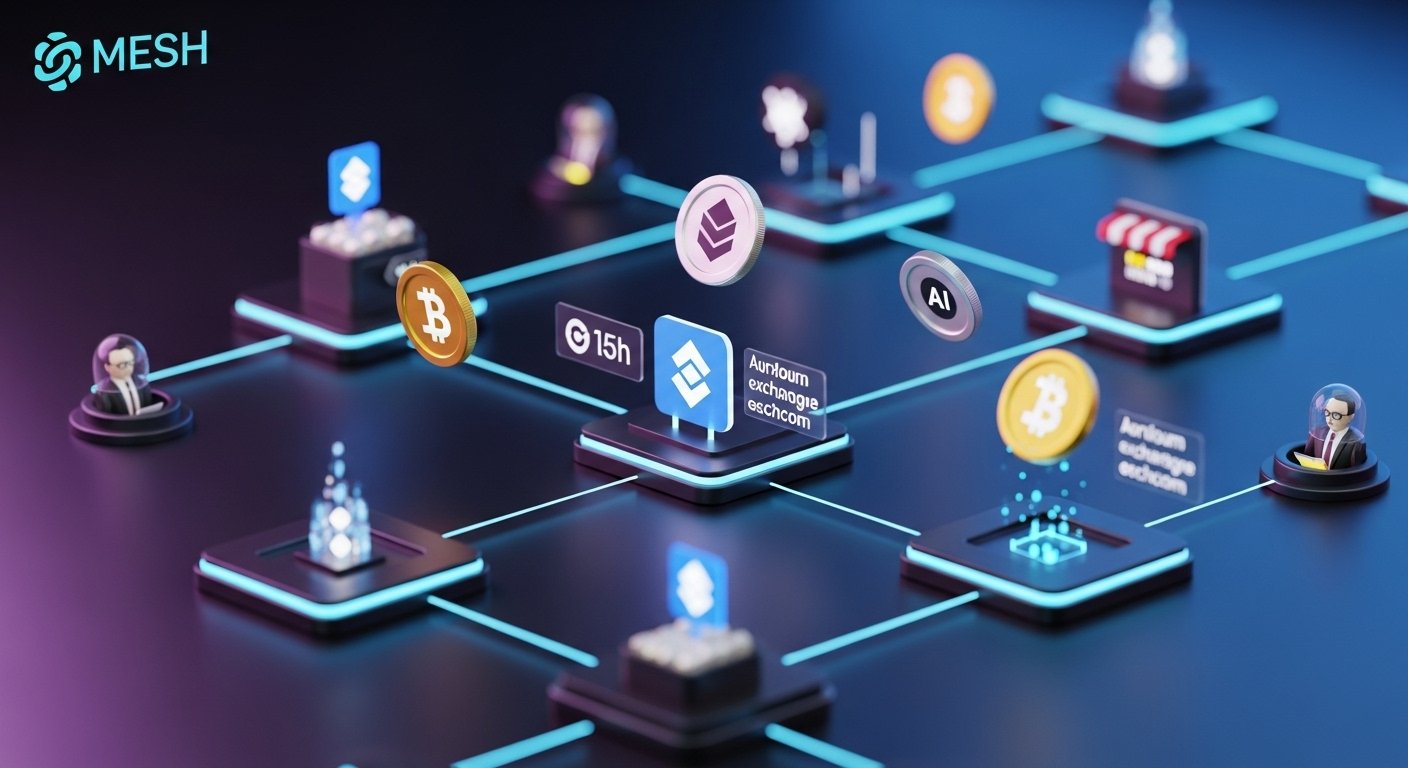
The global financial ecosystem is witnessing a foundational restructuring as the boundaries between traditional fiat systems and decentralized blockchain networks dissolve. At the vanguard of this transition is Mesh, a global crypto payments network formerly known as Front Finance, which has emerged as the critical connectivity layer for the modern digital economy. The evolution of Mesh from a specialized finance tool to a comprehensive “financial operating system” signifies a shift in how enterprises and retail users interact with digital assets. By integrating over 300 platforms—encompassing centralized exchanges (CEXs), self-custody wallets, and traditional payment service providers (PSPs)—Mesh is addressing the fragmentation that has historically stifled the utility of cryptocurrency as a medium of exchange. This analysis explores the technical architecture of the Mesh stack, the strategic implications of its $130 million funding trajectory, and its pioneering role in “agentic commerce,” where artificial intelligence (AI) agents autonomously execute complex financial transactions.
The Genesis of Connectivity: From Front Finance to the Mesh Operating System
The transition from Front Finance to Mesh in 2020 was not merely a rebranding exercise but a strategic pivot toward solving the “Interoperability Gap” in decentralized finance (DeFi). In the early stages of the crypto market, assets were trapped within siloed environments. A user might hold Bitcoin on Coinbase, Ethereum in a MetaMask wallet, and Solana on a different exchange. Transferring these assets to a merchant or another platform required manual, error-prone processes involving long cryptographic addresses and multiple authentication steps. Mesh was founded to build an open, secure, and connected ecosystem that treats these disparate platforms as a single, unified network.
The core mission of the Mesh network is to provide enterprise clients with the ability to enable digital asset transfers, crypto payments, account aggregation, and even registered securities trading within their own platforms. This is achieved through a suite of Application Programming Interfaces (APIs) and client-side Software Development Kits (SDKs) that abstract the complexity of blockchain interactions for both the developer and the end user.
Core Product Pillar: The Mesh Stack
The Mesh architecture is categorized into three primary capabilities: Pay, Deposit, and Verify. These tools collectively manage the lifecycle of a digital transaction, from establishing trust to the final settlement of funds.
| Capability | Technical Function | Business Outcome |
| Pay | Facilitates crypto payments via the Link SDK with automatic asset conversion. | Merchants accept crypto without managing volatility; users pay with any asset. |
| Deposit | Enables seamless fund transfers from 300+ platforms into a target application. | High-conversion funding for wallets, gaming apps, and trading platforms. |
| Verify | Confirms account ownership and retrieves profile data/wallet signatures. | Streamlined KYC/AML compliance and secure wallet-to-app binding. |
Strategic Funding and Institutional Validation
The viability of Mesh’s infrastructure is reflected in its significant capital accumulation and the caliber of its institutional backers. As of late 2025, Mesh has secured more than $130 million across six funding rounds, positioning it as one of the most well-funded infrastructure providers in the blockchain space.
The Evolution of the Funding Journey
Mesh’s funding history illustrates a progressive increase in valuation and strategic alignment. The company began with foundational seed funding to build its engineering core and has since attracted the largest names in both traditional and digital finance.
| Funding Round | Date | Amount | Lead/Notable Investors | Strategic Focus |
| Seed | Sept 2021 | ~$4,000 | N/A | Foundational infrastructure and proof-of-concept. |
| Seed | June 2022 | $5.5M | Streamlined Ventures, WndrCo | Refining product and hiring core engineering team. |
| Series A | Sept 2023 | $22M | Money Forward, Galaxy | Product development and rapid scaling. |
| Series A | Jan 2024 | $5M | PayPal Ventures | Core technology advancements and rollout. |
| Series A | Aug 2024 | Undisclosed | QuantumLight (Revolut CEO) | Market entry and deepening financial integrations. |
| Series B | March 2025 | $82M | Paradigm, Consensys | Global payments network expansion and API scaling. |
| Additional | Aug 2025 | $10M+ | PayPal/Coinbase Ventures | Reaching total funding of >$130M. |
The Series B round in March 2025, led by Paradigm, marked a historic moment for the company. The participation of Consensys (the parent company of MetaMask) and QuantumLight Capital (led by Nik Storonsky) highlights the network’s importance to both the decentralized wallet ecosystem and the neobanking sector.
Stablecoin Settlement as a Proof of Concept
A defining characteristic of Mesh’s funding rounds—specifically the Series B and the August 2025 strategic investment—was the use of stablecoins for settlement. Rather than relying on traditional bank wires, which are subject to delays, high fees, and geographic restrictions, the majority of these investments were settled in PayPal USD (PYUSD).
Mesh utilized its own technology to facilitate these multi-million dollar transfers, proving that its infrastructure is capable of handling high-stakes institutional capital movement with instant, 24/7 finality. This “eating your own dog food” approach has served as a powerful marketing tool, demonstrating the practical advantages of stablecoin-native rails over legacy SWIFT or ACH systems.
Technical Deep Dive: The Mechanics of SmartFunding
The most significant technical hurdle in crypto payments is the “mismatch problem.” Users often hold a variety of cryptocurrencies, but merchants almost exclusively prefer settlement in stablecoins or fiat to avoid the risks of price volatility and to simplify accounting. Mesh addresses this through its proprietary SmartFunding orchestration engine.
Real-Time Asset Conversion
SmartFunding acts as an intelligent bridge. When a user initiates a payment, the engine dynamically assesses the user’s connected accounts to identify eligible assets. If a user chooses to pay with Bitcoin (BTC) but the merchant requires USDC, SmartFunding executes a real-time conversion. This process happens entirely within the background of the transaction, requiring no manual intervention, additional logins, or separate swap steps by the user.
The efficiency of this system is evident in its performance metrics. Platforms integrating SmartFunding have reported a 70% increase in deposit success rates. By collapsing the multi-step “swap-then-pay” process into a single click, Mesh has brought the usability of crypto payments to parity with traditional credit card transactions.
The Link SDK: Unified Interface for 300+ Platforms
The frontend manifestation of this technology is the Link SDK, a set of client-side modules for Web, iOS, Android, React Native, and Flutter. The SDK provides a pre-built UI that handles the complexities of:
- Credential Validation: Securely logging into centralized exchange accounts.
- Multi-Factor Authentication (MFA): Handling the various 2FA methods used by different institutions.
- Error Handling: Managing connection timeouts or insufficient balance alerts across hundreds of different API endpoints.
By providing this “drop-in” modal, Mesh allows developers to support a massive range of exchanges (Coinbase, Binance, ByBit, OKX) and wallets (MetaMask, self-custody options) without needing to maintain individual integrations for each.
Agentic Commerce: The Future of Autonomous Finance
While real-time payments represent the current state of the art, Mesh is positioning itself for a future defined by AI-driven commerce. In October 2025, the company unveiled the Mesh AI Wallet (MAI), a tool designed to enable “agentic commerce”.
The Role of AI Agents in Payments
Agentic commerce refers to a paradigm where AI agents perform financial transactions autonomously on behalf of users. During a live demo at TOKEN2049, Mesh demonstrated an AI agent completing a real-world purchase of physical goods using stablecoins. The user provided a simple prompt—”Buy a bag of dog food from this retailer”—and the agent handled the entire backend process:
- Identifying the required amount in stablecoins.
- Connecting to the user’s funded wallet.
- Executing the SmartFunding conversion.
- Completing the checkout on the merchant’s platform.
Support for the Agent Payments Protocol (AP2)
To ensure interoperability in this new sector, Mesh has integrated support for Google’s Agent Payments Protocol (AP2). AP2 is an open framework developed by Google in collaboration with leaders like Coinbase and the Ethereum Foundation to provide a common language for secure, compliant transactions between AI agents and merchants.
Mesh’s role as the “connective layer” is crucial here. While an AI agent might understand the intent to buy, it requires a secure infrastructure to access funds across different platforms and orchestrate the conversion. Mesh provides the “programmable rails” that make this possible, allowing agents to tap into the $200 billion stablecoin market and the $3 trillion broader crypto market.
| Entity | Role in Agentic Commerce |
| User | Provides high-level intent (e.g., natural language prompt). |
| AI Agent | Deciphers the prompt, selects the merchant, and initiates the payment. |
| Google AP2 | Provides the standardized protocol for agent-merchant communication. |
| Mesh Network | Connects the agent to the user’s funds and performs real-time conversion. |
| Merchant | Receives instant settlement in stablecoins or fiat. |
Security, Compliance, and Enterprise Standards
As Mesh bridges the gap between decentralized assets and institutional finance, it must adhere to the highest standards of security and regulatory compliance. The platform’s infrastructure is designed with a “security by design” philosophy, ensuring that safety is not an afterthought but a core component of the architecture.
The Zero Trust Model
Mesh employs a zero-trust, least-privilege access model. This architecture assumes that no user or system is inherently trustworthy, requiring constant verification for every access request. Key security features include:
- Encryption: Data is encrypted both at rest and in transit using industry-standard algorithms.
- SOC 2 Type II Certification: Mesh undergoes regular third-party audits to verify its operational and infrastructure-level security controls.
- Penetration Testing: Regular, comprehensive testing by reputable third-party security firms simulates real-world attacks to identify and remediate vulnerabilities before they can be exploited.
Data Privacy and KYC Integration
Compliance with Know Your Customer (KYC) and Anti-Money Laundering (AML) regulations is mandatory for enterprises operating in the U.S. and EU. Mesh facilitates this through its “Verify” capability. For centralized exchanges, Mesh can retrieve basic profile data to assist in user identification. For self-custody wallets, Mesh provides a gasless verification method where users sign a message to prove ownership of an address without revealing sensitive private keys. Importantly, Mesh minimizes the storage of end-user Personally Identifiable Information (PII), handling it only temporarily when required to facilitate a transaction.
Industry Adoption and Strategic Partnerships
The utility of the Mesh network is demonstrated by its integration into some of the most widely used financial products in the world.
The PayPal Partnership
A landmark achievement for Mesh is its role in powering PayPal’s “Pay with Crypto” service. By integrating Mesh’s SmartFunding engine, PayPal allows its consumers to pay with a wide range of cryptocurrencies while ensuring that PayPal merchants receive instant settlement in stablecoins or fiat. This partnership gives Mesh access to hundreds of millions of users and significantly accelerates the mainstream adoption of digital asset payments.
MetaMask and Wallet Hubs
MetaMask, the leading self-custody wallet, has utilized Mesh to evolve into a “true crypto hub.” By integrating Mesh, MetaMask allows users to aggregate assets from their centralized exchange accounts, perform seamless deposits, and access native ramp services without leaving the wallet interface. This reduces the “app-hopping” friction that previously defined the Web3 user experience.
Merchant and PSP Integrations
Beyond the crypto-native world, Mesh has partnered with legacy payment giants like Shift4. This integration enables over 200,000 merchants across 45+ countries to accept crypto payments that are automatically converted into local fiat currencies. For merchants, this unlocks new revenue streams from the global pool of 650 million crypto users without introducing the complexity of managing digital asset wallets or volatility.
Market Projections and Economic Impact
The financial opportunity for a global crypto payments network is vast. The global online payments market is projected to reach $17 trillion by 2027. Mesh’s leadership believes that capturing even 10% of this market through “pay with crypto” solutions represents a $1.7 trillion opportunity.
The Dominance of Stablecoins
The growth of Mesh is intrinsically linked to the rise of stablecoins. In 2024, stablecoins processed over $27.6 trillion in transaction volume, surpassing the scale of Visa and Mastercard combined. With a market capitalization exceeding $200 billion, stablecoins have become the preferred medium for both settlement and cross-border transfers.
Mesh is positioning itself as the primary infrastructure for this “stablecoin-dominated ecosystem”. By supporting a wide array of stablecoins—including PayPal’s PYUSD, Circle’s USDC, and Ripple’s forthcoming RLUSD—Mesh ensures that it remains chain-agnostic and settlement-flexible.
Differentiating Mesh: Payments Network vs. Computing Topology
It is essential to distinguish between the company Mesh (meshconnect.com) and the broader concept of “mesh networking” in computer science. While the company takes its name from the idea of interconnected nodes, its application is purely financial.
Mesh Networking (IoT and Data)
Traditional mesh networking is a decentralized structure where devices (nodes) connect directly and dynamically to multiple other nodes. It is used in IoT for self-healing, scalable data distribution (e.g., smart lighting or industrial machinery sensors).
Mesh Crypto Payments Network
The Mesh crypto network is a software-defined connectivity layer that connects different financial “nodes”—specifically the accounts held by users at various exchanges and wallets. Its “mesh” quality comes from its ability to route value between any two points in the global financial system, regardless of which platform the assets are currently stored on.
| Feature | Traditional Mesh Networking | Mesh Crypto Payments Network |
| Primary Unit | Data packets (bits/bytes). | Digital assets (tokens/currency). |
| Nodes | Physical devices (routers, sensors). | Financial institutions (CEXs, wallets). |
| Goal | Efficient data distribution. | Instant value settlement. |
| Key Advantage | Self-healing, no central failure point. | Interoperability, no “walled gardens.” |
Implementation Guide: Integrating the Mesh Stack
For professional developers and enterprise architects, integrating with Mesh follows a structured, API-first approach designed to minimize development time while maximizing security.
Step-by-Step Integration Workflow
- Backend Initialization: The host application makes a server-to-server call to the Mesh API to request a
linkToken. This token is single-use and configures the parameters of the user session (e.g., which exchanges to show, what assets to accept). - Frontend Deployment: The Mesh Link SDK is initialized on the client side using the
linkToken. This launches the Mesh modal, which handles the entire authentication and MFA flow. - Authentication and Permissioning: The user logs into their exchange or signs a message with their wallet. Mesh validates the credentials and, if successful, provides the host application with an
accessToken. - Transaction Execution: Using the
accessToken, the host application can initiate transfers, verify balances, or trigger a SmartFunding payment. - Event Listening: The host application listens for SDK events (e.g.,
onSuccess,onExit) to update its own UI and state in real-time.
Best Practices for Enterprise Deployment
- Layer-2 Strategy: For retail payments, developers should prioritize Layer-2 (L2) networks like Base or Polygon to ensure low transaction costs while maintaining the security of the Ethereum mainnet.
- Modular Design: Push non-critical business logic off-chain and use the Mesh API for final settlement and UX.
- Zero-Knowledge Proofs (zk-KYC): Where privacy is a priority, consider using zk-proofs to verify user compliance without disclosing PII to the merchant.
Conclusion: The Path Toward a Connected Financial Future
The analysis of the Mesh crypto payments network reveals a strategic vision that extends far beyond simple asset transfers. By securing over $130 million in funding and establishing partnerships with global leaders like PayPal and Shift4, Mesh has validated the demand for a unified connectivity layer in digital finance. The network’s ability to solve the mismatch problem through SmartFunding and to pioneer agentic commerce through the MAI wallet marks a significant leap toward the “invisibility” of crypto payments—a state where digital assets are as simple and secure to use as a credit card.
As the global online payments market moves toward the $17 trillion mark, the infrastructure that connects fragmented wallets and exchanges will become the backbone of the global economy. Mesh is not merely a payment gateway; it is the connective tissue of a new financial operating system, ensuring that anyone can pay with any asset, anywhere in the world, with zero operational friction. For enterprises, the message is clear: the future of commerce is decentralized, programmable, and interconnected, and the “mesh” architecture is the key to unlocking its full potential.
FAQ’S
Mesh is a global crypto payments network that connects wallets, exchanges, and payment platforms into a single ecosystem. It allows users and merchants to transfer digital assets seamlessly using its Smart Funding technology for real-time conversions.
Unlike standalone wallets or exchanges, Mesh integrates over 300 platforms, enabling instant payments, automated asset conversions, and enterprise-level connectivity, bridging the gap between fiat, stablecoins, and cryptocurrencies.
Mesh supports “agentic commerce,” where AI agents can autonomously execute financial transactions on behalf of users, such as paying merchants or converting crypto, using the Mesh AI Wallet (MAI) and Agent Payments Protocol (AP2).
Yes. Mesh follows a zero-trust security model, encrypts all data, undergoes SOC 2 Type II audits, and integrates KYC/AML compliance, ensuring safe and regulated transactions for enterprises and users