
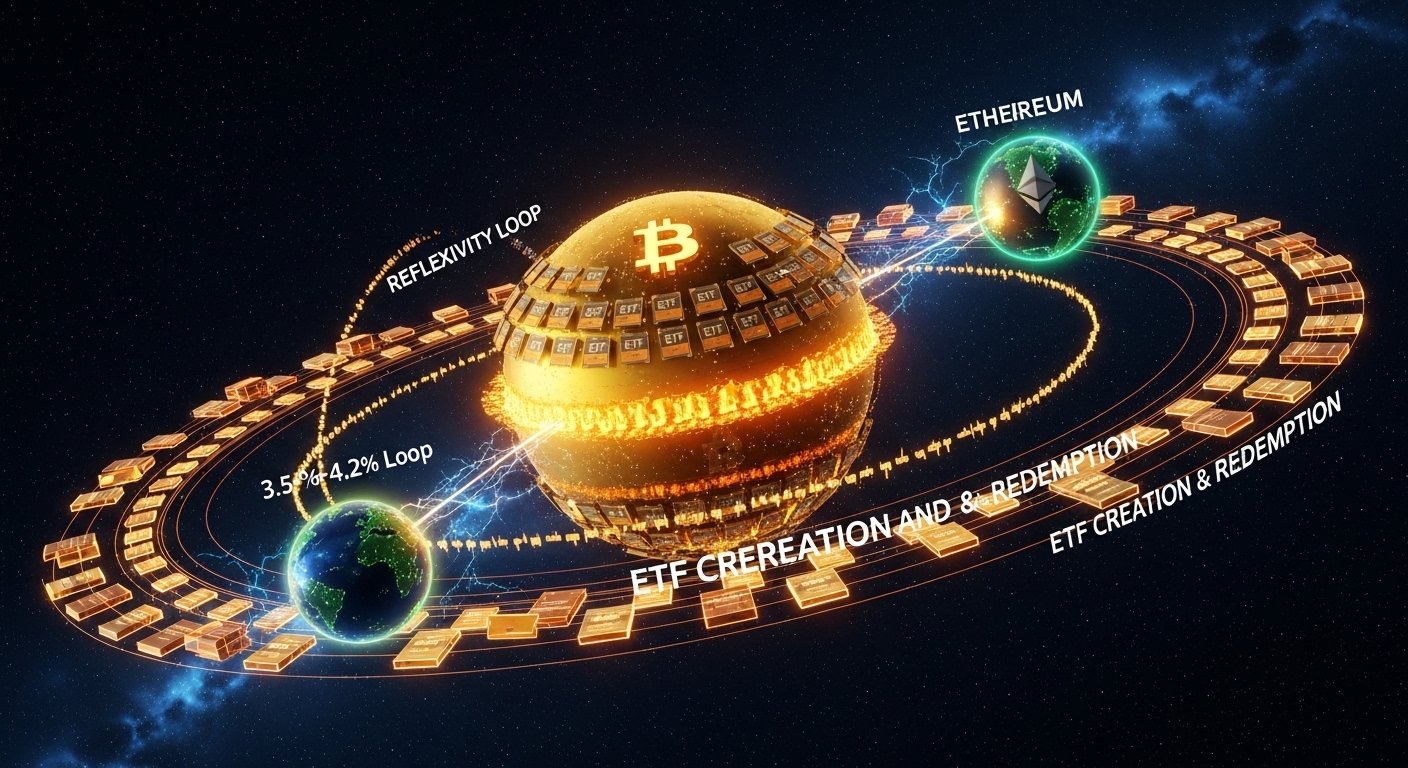
In the early days of 2024, the launch of Spot Bitcoin ETFs was treated as a speculative “event.” Today, in February 2026, cryptocurrency ETF flows have become the primary pulse of the global digital asset market. For the modern investor, understanding these flows is no longer optional—it is the baseline for price discovery.
As of Q1 2026, the “Wild West” era of crypto volatility has been significantly dampened by the “Institutional Wrapper.” However, as we saw in the recent January 2026 “Cold Wave”—where US spot ETFs saw a record $2.6 billion in net outflows—the relationship between institutional capital and token price is more complex than a simple “buy equals up” equation.
This guide dissects the mechanics, the players, and the predictive power of ETF flows in a mature, 2026 regulatory environment.
1. Understanding the Mechanics: The “Create/Redeem” Engine
To analyze flows, one must first understand that ETF “buying” is not the same as a retail trader clicking “buy” on an exchange. It is a multi-step arbitrage process governed by Authorized Participants (APs) like Jane Street, JPMorgan, and Goldman Sachs.
The Creation Process
When there is a surge in demand for an ETF (e.g., BlackRock’s IBIT), the market price of the ETF shares may begin to trade at a premium to the Net Asset Value (NAV) of the underlying Bitcoin.
- The AP notices this premium.
- The AP buys “spot” Bitcoin on the open market (Coinbase Prime, Kraken, etc.).
- The AP delivers that Bitcoin to the ETF issuer (e.g., BlackRock).
- In exchange, the issuer gives the AP a freshly minted “Creation Unit” of ETF shares.
- The AP sells these shares on the stock market, pocketing the premium and equalizing the price.
Why this matters for SEO/Analysis: Inflows are often “lagged.” A massive price spike on Monday might not show up in the “Official Net Flow” data until Tuesday or Wednesday due to T+1 settlement cycles.
The Redemption Process (The Outflow Mechanic)
Conversely, when an ETF trades at a discount, APs buy the cheap ETF shares, trade them back to the issuer for the underlying Bitcoin, and sell that Bitcoin on the spot market. This is the primary driver of “sell pressure” during market corrections.
2. Historical Context: From 2024 Launch to 2026 Maturity
The trajectory of crypto ETF flows can be divided into three distinct epochs:
Phase I: The Honeymoon (Jan 2024 – Dec 2024)
Characterized by massive “pent-up” demand. IBIT and FBTC became the fastest-growing ETFs in history, reaching $10 billion in AUM within weeks. During this phase, flows were almost exclusively positive as retail-heavy advisors moved client money into the new “safe” wrapper.
Phase II: The Great Rotation (Jan 2025 – Oct 2025)
This era was defined by the Grayscale Exodus. As investors fled high-fee legacy products (GBTC and ETHE) for lower-cost alternatives, “Net Flows” often looked flat or negative despite Bitcoin hitting $120,000 in October 2025. This was the “noise” era where analysts had to look deeper than the headline numbers.
Phase III: The Steady State (Nov 2025 – Present)
In 2026, we have entered the “Steady State.” Inflows are no longer driven by novelty but by Model Portfolios. Large-scale wealth managers (Morgan Stanley, UBS) have now integrated a 1–3% “Digital Gold” allocation into their automated rebalancing tools.
Data Insight: In January 2026, despite a 22% price drawdown, European crypto ETFs remained net positive by EUR 340 million, signaling that “Old World” capital is currently more “diamond-handed” than US-based speculative flows.
3. Bitcoin ETF Flows vs. Price Action: The Correlation Analysis
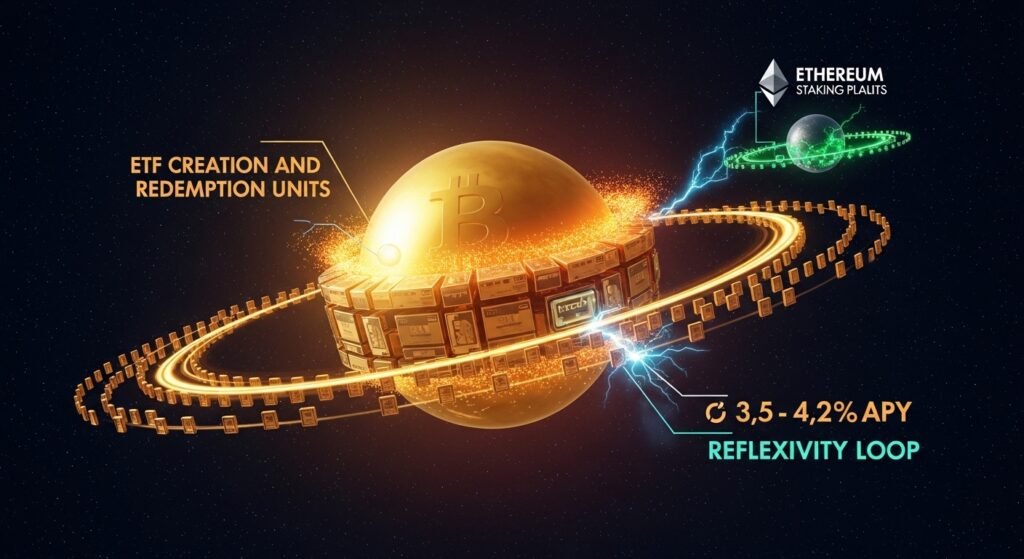
Does the flow drive the price, or does the price drive the flow? In 2026, the answer is a Reflexivity Loop.
The “Flow Exhaustion” Indicator
We have identified a recurring pattern: when net inflows exceed $800 million per day for more than five consecutive trading days, the market typically reaches a short-term “local top.” This is because institutional demand has sucked up all available exchange liquidity, leading to a “blow-off top” followed by a period of consolidation.
Table 1: Correlation of Net Flows to BTC Price (2025-2026)
| Period | Avg. Daily Net Flow (US) | BTC Price Action | Market Sentiment |
| Q3 2025 | +$450M | +18% | Aggressive Bull |
| Q4 2025 (Peak) | +$1.2B | +35% | Euphoria |
| Jan 2026 | -$310M | -22% | Risk-Off / Fear |
| Feb 2026 (Mid) | +$85M | +4% | Stabilizing |
Key Takeaway: In 2026, the “Floor” price of Bitcoin is increasingly determined by the AUM of these ETFs. With roughly $110 billion locked in US spot ETFs, the “selling” capacity of the market is structurally different than the 2021 cycle.
4. The Ethereum ETF Divergence
While Bitcoin ETFs are viewed as “Digital Gold,” Ethereum ETFs (ETHA, FETH) have behaved differently in 2025 and 2026.
The Staking Yield Gap
The primary friction for Ethereum ETF flows in early 2026 remains the lack of In-Kind Staking. Institutional investors who buy the ETF wrapper currently “miss out” on the ~3.5% – 4.2% APY staking yield available to native ETH holders.
- Result: ETH ETF flows have been “sticker” but slower.
- Case Study: In Q4 2025, while Bitcoin saw record inflows, Ethereum ETFs saw a 12-day outflow streak as capital rotated into “Yield-Bearing” private crypto funds.
The Harvard Signal
In a landmark 13F filing in February 2026, the Harvard Management Company revealed an $87 million position in iShares Ethereum Trust (ETHA). This represents a “Quality Pivot”—institutional giants are moving past “just Bitcoin” and treating Ethereum as “Global Financial Infrastructure.”
5. Institutional Archetypes: Who is Moving the Needle?
Not all flows are created equal. To predict the next market move, you must identify which institution is buying.
A. The “Basis Trade” (The Arbitrageurs)
In 2026, a significant portion of ETF inflows is “Non-Directional.” Hedge funds engage in the Cash-and-Carry Trade:
- They buy the Spot ETF (Inflow).
- They sell the equivalent Bitcoin Futures on the CME (Short).
- They pocket the “Basis” (the difference in price).
- Impact: This inflates “Inflow” numbers without actually creating upward price pressure.
B. Pension Funds & Endowments (The “Sticky” Money)
When we see inflows into ETFs like Fidelity’s FBTC or Bitwise’s BITB during a market crash, it is usually pension funds rebalancing. This is “Sticky Money”—it will not sell for 5–10 years.
C. The RIA (Registered Investment Advisor) “Slow” Money
This is the largest untapped pool. As of Feb 2026, only about 35% of US advisors have received compliance clearance to buy crypto ETFs for clients. This “structural lag” ensures a steady stream of inflows for the next 24 months, regardless of short-term price volatility.
6. Global Landscape: US vs. The World
While the US SEC-regulated ETFs dominate volume, the “Global Flow” tells a deeper story.
- Hong Kong: The HK SFC’s decision to allow “In-Kind” Redemptions (allowing investors to trade ETF shares for actual Bitcoin/Ether) has made HK a hub for the “Whale” class. In Q1 2026, HK flows have acted as a “buffer” during US market hours.
- Europe: The European ETP market is more fragmented but more resilient. As noted in recent Morningstar data, European investors have shown a higher tolerance for the 2026 “January Cold Wave” than their US counterparts.
7. Technical SEO: Predictive Modeling & “Flow Exhaustion”
Investors can use the following formula to estimate the “ETF-Implied Price” of Bitcoin:
$$P_{implied} = \frac{Total\ AUM}{Circulating\ Supply \times \%Held\ by\ ETFs}$$
In 2026, when the percentage of BTC held by ETFs exceeds 6.5%, we enter a “Liquidity Crunch” zone. Currently, with ETFs holding roughly 5.8% of all Bitcoin, the market remains in a “Balanced” state.
How to Spot a Market Bottom Using Flows
- The Washout: Look for 3 consecutive days of $200M+ outflows.
- The Divergence: Price continues to fall, but outflows begin to shrink (e.g., -$200M -> -$50M -> -$5M).
- The Pivot: The first day of “Neutral” or slightly positive flows ($10M+) often marks the exact bottom of a correction.
8. FAQ: Cryptocurrency ETF Flows
Q: Why did Bitcoin drop in Jan 2026 despite positive ETF flows in 2025?
A: This was likely a “Tax Loss Harvesting” and “Profit Taking” event. Institutions that bought at $40,000 in early 2024 took gains after the 2025 peak of $120,000, creating a temporary supply-demand imbalance.
Q: Do ETF flows affect the price of altcoins?
A: Yes, via the “Liquidity Waterfall.” When Bitcoin ETFs see massive inflows, it increases the overall “Wealth Effect” in the crypto market, leading investors to rotate profits into Solana (SOL) and XRP ETFs, which saw their first major inflows in early 2026.
Q: Where can I track real-time flow data?
A: Farside Investors, BitMEX Research, and Bloomberg Terminal (for professionals) are the gold standards. Avoid “Social Media Leaks” which often confuse “Exchange Inflows” with “ETF Inflows.”
9. Conclusion: The Roadmap Ahead
The “Institutionalization” of cryptocurrency is no longer a theory; it is a balance sheet reality. As we move through 2026, the “Alpha” (the edge) in the market is no longer found in reading whitepapers, but in reading the Flow Tape.
If you are a long-term investor, the signal is clear: Watch the 13F filings. When university endowments and state pension funds move from “Zero” to “One,” the structural bid for crypto becomes permanent.