

Introduction
Something significant is happening in the world of robotics — and money is at the center of it. Over the past year, investors have poured billions of dollars into robotics companies at a pace the industry has never seen before. Whether it’s humanoid robots walking across factory floors or autonomous excavators breaking ground on construction sites, the race to fund the next generation of intelligent machines is officially on.
If you follow tech investment news, you’ve likely noticed robotics appearing in headlines more often. That’s not a coincidence. This article breaks down what’s driving all this funding, which companies are attracting the biggest checks, and what it all means for the future — whether you’re an investor, a curious reader, or someone who works in a field that robots are beginning to enter.
Why Robotics Is Attracting Record Investment
The simplest answer is: AI changed everything. For years, robotics was held back by a major gap — robots could do repetitive tasks well, but they struggled to adapt. The rise of large AI models and advanced machine learning has begun to close that gap, making robots far more capable, flexible, and commercially viable.
Investors are also responding to a real-world labor problem. Across manufacturing, construction, healthcare, and logistics, companies are facing persistent worker shortages. The construction industry alone needs nearly 800,000 workers over the next two years to keep up with demand, with retirements further widening the labor gap. Robots aren’t just a futuristic luxury anymore — for some sectors, they’re becoming a practical necessity.
This combination of improved AI, labor scarcity, and proven early deployments has made robotics one of the hottest categories in venture capital today.
The Numbers: Funding Has Hit a Record High
The scale of investment flowing into robotics is staggering.
Robotics startups raised nearly $14 billion in funding in 2025, up from $8.2 billion in 2024, and even surpassing the $13.1 billion raised during the peak venture funding year of 2021. This isn’t a temporary blip — it reflects a structural shift in how investors see the sector.
In the first seven months of 2025 alone, robotics startups raised over $6 billion. But deal count dropped from 671 rounds in 2023 to 473 in 2024 — meaning fewer companies are getting funded, but the ones that do are raising massive rounds. This “concentration effect” is important: the money is flowing toward a smaller number of companies that have demonstrated real technical progress and clear paths to commercial deployment.
Major Funding Rounds Making Headlines
Apptronik and the Humanoid Robot Wave
The biggest recent story in robotics funding is Austin-based Apptronik. Humanoid robotics startup Apptronik was valued at $5 billion in a funding round that included capital from Google. The company’s Apollo humanoids are being tested in factories and warehouses with partners Mercedes-Benz and GXO Logistics.
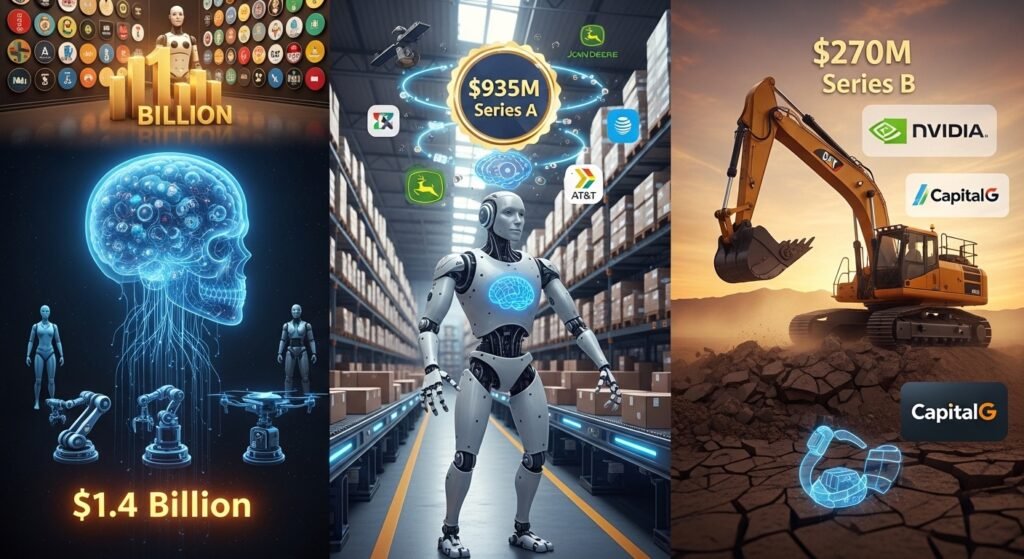
Apptronik raised $520 million in an extension of its $415 million Series A from February 2025, bringing the total round to over $935 million. Existing backers B Capital, Google, Mercedes-Benz, and Peak6 joined new investors including AT&T Ventures and manufacturing giant John Deere.
What’s notable about Apptronik is their business model. Rather than selling robots outright, they operate on a Robotics as a Service (RaaS) model — providing hardware, software updates, and ongoing support. This makes adoption easier for large customers who don’t want to manage robot fleets themselves. The company also has a strategic partnership with Google DeepMind, using Gemini Robotics AI models to power Apollo’s decision-making capabilities.
Skild AI: $1.4 Billion for a Universal Robot Brain
Skild AI, a robotics company building an “omni-bodied” brain to operate any robot for any task, announced in January 2026 that it had raised $1.4 billion, tripling its valuation to more than $14 billion. The concept — a single AI system that can control different robot types — could be a game-changer if it works at scale.
Bedrock Robotics: Autonomous Construction Gets a $270M Boost
Bedrock Robotics, a leader in autonomous construction technology, raised $270 million in Series B funding co-led by CapitalG and the Valor Atreides AI Fund, with participation from NVIDIA’s venture capital arm, MIT, and others. This brought Bedrock’s total funding to over $350 million.
Founded by former Waymo engineers, Bedrock is targeting fully operator-less excavator deployments in 2026 — meaning construction equipment that works without a human in or near the cab.
Figure’s Billion-Dollar Milestone
Figure recruited half a dozen corporate investors to raise $1 billion in 2025 — the first-ever billion-dollar round for a robotics startup. That milestone made it clear that robotics had graduated from a niche engineering sector into a mainstream investment category.
Surgical Robotics: Surgerii’s $100M Series D
The funding boom isn’t limited to humanoids and construction machines. Surgerii Robotics raised $100 million in a Series D funding round to scale manufacturing, clinical adoption, and regulatory efforts as it competes in the global surgical robotics market. Medical robotics is another area drawing serious capital, driven by aging populations and growing demand for minimally invasive procedures.
Key Trends Shaping Robotics Investment Today
AI is now the core of every serious robotics startup. Investment in robotics with autonomous vehicle use cases fell from representing 70% of robotics funding in 2019 to just 30% in 2023. The market has shifted toward vertical robotics solving specific industry problems — humanoid robots, surgical systems, warehouse automation, and agricultural robotics.
Humanoid robots are moving from labs to real workplaces. Humanoid robots are moving from lab demonstrations to warehouse deployments, with commercial robots moving over 100,000 totes at logistics facilities.
Tesla is a looming presence. Tesla is planning to spend $20 billion on capital expenditures in 2026 to ramp up production of its Optimus robot and self-driving cars, though CEO Elon Musk has acknowledged the Optimus humanoids remain in an early research and development stage.

Corporate players are getting involved as investors. It’s no longer just traditional VC firms writing checks. Companies like Google, John Deere, Mercedes-Benz, AT&T Ventures, and NVIDIA’s investment arm are all backing robotics startups — bringing strategic value beyond just money.
Challenges the Industry Still Faces
Despite the excitement, building robots is genuinely hard — and expensive. Hardware development doesn’t move at software speed.
Robotics startups need significantly more capital at each stage than software companies. Development cycles from concept to working prototype typically run 18 to 24 months. And once a prototype works, scaling to manufacturing introduces a whole new set of challenges around supply chains, quality control, and safety certification.
The concentration of funding into fewer companies also means many smaller robotics startups may struggle to raise competitive rounds. If you’re not already well-connected or don’t have a marquee partnership, getting in front of the right investors has become harder even as the total dollars available have grown.
What This Means for the Future
The wave of robotics investment we’re seeing today is laying the foundation for significant changes across multiple industries within the next five to ten years. Warehouses, construction sites, hospitals, and eventually homes are all in the crosshairs of companies building intelligent machines.
The humanoid robotics market is projected to witness a compound annual growth rate of 39.2%, with global robotics funding surpassing $10.3 billion in 2025. Early signals suggest 2026 is on track to match or exceed that momentum.
For everyday people, this matters beyond the stock market. Robots entering the workforce at scale will reshape which jobs are in demand, what skills are valued, and how industries organize their operations. Getting familiar with these trends now — before they fully arrive — is genuinely useful.
Conclusion
Robotics funding has entered a new era. The combination of advanced AI, clear industrial demand, and massive capital from both venture firms and strategic corporate investors is accelerating the commercialization of robots faster than most people expected even five years ago.
Companies like Apptronik, Skild AI, Bedrock Robotics, and Figure are at the front of this wave, each targeting different industries with different technical approaches. But they share a common thread: robots that can actually do useful work in the real world, not just impress in a lab.
Whether you’re tracking this as an investor, a business owner preparing for automation, or simply someone curious about where the technology is heading — one thing is clear: the money is flowing, and the machines are coming.
FAQs
Robotics funding is rising due to advancements in AI technology, global labor shortages, and increasing demand for automation across industries like manufacturing, logistics, healthcare, and construction.
Robotics startups raised nearly $14 billion in 2025, marking a record-breaking year for investment in intelligent machine technologies.
Robotics as a Service (RaaS) is a business model where companies lease robotic systems with ongoing software updates and support instead of purchasing them outright.
Yes, robotics is expected to reshape job roles, increase demand for technical skills, and automate repetitive labor-intensive tasks.