

The transformation of the retail landscape over the past two decades has been punctuated by the institutionalization of specific “shopping holidays” that dictate global supply chain rhythms and consumer spending patterns. Among these, Cyber Monday stands as the preeminent digital milestone, representing the peak of the annual e-commerce cycle. Originally conceived as a marketing mechanism to bridge the gap between traditional brick-and-mortar sales and the burgeoning world of online retail, Cyber Monday has evolved into a multi-billion-dollar global event that reshapes how products are discovered, purchased, and delivered. This analysis provides an exhaustive examination of its historical origins, technological catalysts, macroeconomic impacts, and the sophisticated consumer strategies required to navigate an increasingly complex digital marketplace.
The Historical Trajectory and Socio-Technical Foundations
To understand the current dominance of Cyber Monday, one must first examine the specific technological constraints and cultural shifts of the early 21st century. The term was formally introduced on November 28, 2005, by Ellen Davis of the National Retail Federation (NRF) and Scott Silverman of Shop.org. The genesis of the holiday was rooted in a practical observation: after a weekend of Thanksgiving festivities and “window shopping” at physical malls, millions of American workers returned to their offices on Monday and utilized their employers’ high-speed broadband connections to finalize purchases. In 2005, roughly 40% of Americans with home computers still relied on slow dial-up connections, making the corporate office the most efficient environment for the relatively “awkward” process of early e-commerce.
While the term “Cyber Monday” was a marketing invention, the behavior it described was already manifest. Research from 2004 had identified the Monday after Thanksgiving as the 12th-biggest online shopping day of the year, a trend that retailers were eager to capitalize upon. Before Davis coined the modern term, other industry figures had attempted to label similar windows; for instance, in 2003, Tony Valado of 1800flowers.com proposed “White Wednesday” as a digital alternative occurring the day before Thanksgiving. However, Cyber Monday captured the public imagination because it aligned perfectly with the post-holiday return to work and the burgeoning desire for a safer, less chaotic alternative to the often violent “doorbuster” rushes of Black Friday.
As the retail industry moved through the late 2000s, Cyber Monday underwent a series of critical milestones that solidified its status. The 2008 Great Recession, paradoxically, served as a catalyst for growth, as cash-strapped consumers turned to online retailers to find deeper discounts and avoid the fuel costs associated with traveling to physical stores. By 2010, the event surpassed $1 billion in single-day sales for the first time. The subsequent decade saw the rise of the smartphone, which decoupled Cyber Monday from the office desktop and allowed the event to expand into a “24-hour mobile frenzy”.
Milestone Evolution of Cyber Monday (2005–2025)
| Year | Key Evolutionary Milestone | Economic Impact/Context |
| 2005 | Formal Coining of “Cyber Monday” | NRF identifies the broadband-at-work trend. |
| 2006 | Rapid Retailer Adoption | Total sales reach $608 million, up 26%. |
| 2008 | Global Expansion Begins | Canada and France adopt the concept. |
| 2010 | The Billion-Dollar Barrier | Cyber Monday sales officially exceed $1 billion. |
| 2012 | Mobile Commerce Emergence | Smartphones begin to influence shopping behavior. |
| 2014 | Globalization Matures | Events launch in Chile, Colombia, and Australia. |
| 2019 | The Online Parity Shift | Black Friday online sales briefly challenge Monday totals. |
| 2020 | Pandemic Acceleration | COVID-19 pushes the entire holiday season online. |
| 2024 | Record-Breaking Volume | Sales hit $13.3 billion with 57% mobile share. |
| 2025 | The AI Integration Era | Record $14.25 billion spend; massive AI referral growth. |
The evolution of Cyber Monday has not been limited to the United States. It has become a global phenomenon, though its adoption has varied by region. In Canada, the event gained traction in 2008 when the parity of the Canadian dollar with the U.S. dollar prompted domestic retailers to offer competitive sales to prevent capital flight to U.S. websites. In Australia, the concept was adapted into “Click Frenzy” in 2012, which was so popular that many major retail websites crashed under the surge of traffic. Meanwhile, in Europe, Amazon introduced the concept to Germany in 2010, and France followed suit shortly after, integrating Cyber Monday into their existing end-of-year sales traditions.
Quantitative Analysis: Market Performance and Economic Drivers
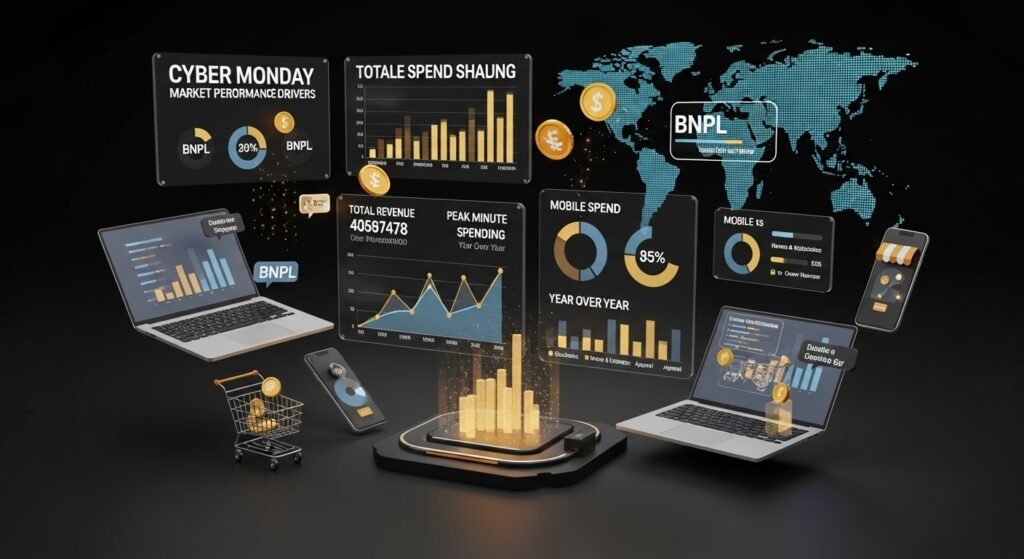
The economic significance of Cyber Monday is best understood through its recent performance data, which highlights a steady, sustainable expansion despite global economic headwinds. In 2024, the event achieved record sales of $13.3 billion, representing a 7.3% increase over the previous year. This momentum continued into 2025, where total spending reached $14.25 billion, equating to an average of $16 million spent every minute during peak hours. This growth is not merely a reflection of inflation; it represents a fundamental shift in consumer volume, with 75.9 million online shoppers participating in 2025, up significantly from 64.4 million in 2024.
Comparative Revenue and Participation Data (2024–2025)
| Metric | 2024 Actuals | 2025 Actuals | Year-over-Year Change |
| Total Online Revenue | $13.3 Billion | $14.25 Billion | +7.14% |
| Online Shopper Count | 64.4 Million | 75.9 Million | +17.8% |
| Mobile Spend Share | 57.0% | 57.7% | +0.7% |
| Peak Minute Spend | $15.8 Million | $16.0 Million | +1.26% |
| BNPL Total Spend | $991.2 Million | $1.03 Billion | +4.2% |
An analysis of these figures suggests a maturing market where double-digit growth has given way to high-single-digit expansion. However, the internal composition of this spending is shifting. A critical driver of modern Cyber Monday volume is the “Buy Now, Pay Later” (BNPL) model. In 2025, BNPL transactions exceeded $1 billion in a single day for the first time in history, signaling that consumers are increasingly relying on flexible payment options to manage their holiday budgets during periods of economic uncertainty. Interestingly, nearly 80% of these BNPL transactions were completed on mobile devices, highlighting the seamless integration of financial technology and mobile commerce.
Furthermore, the “conversion gap” between desktop and mobile users remains a significant metric for retailers. In 2024, desktop users showed a conversion rate of 7.0%, compared to 4.6% for mobile users. This discrepancy suggests that while consumers utilize mobile devices for discovery and casual browsing—accounting for 74% of site traffic—they often return to a desktop environment to finalize complex or high-ticket purchases that require more extensive comparison. This behavior has prompted a strategic response from retailers, who are now prioritizing “one-click” checkouts and progressive web app (PWA) features to reduce friction and close the mobile conversion gap.
Category Dynamics and Discount Architecture
Cyber Monday’s value proposition is heavily concentrated in specific product categories. While Black Friday has historically been associated with large-scale “doorbuster” electronics like televisions and major appliances, Cyber Monday has carved out a niche as the premier day for tech gadgets, fashion, and beauty products. In 2024, electronics dominated the share of sales at 16.4%, followed closely by home and kitchen products at 15.8% and apparel at 14.5%.
Discount Depth and Category Performance (2024–2025 Projections)
| Item Category | 2024 Avg. Discount | 2025 Projected Discount | Sales Volume Surge* |
| Electronics | 30.1% | 28.0% | +452% |
| Toys | 26.1% | 24.0% | +680% |
| Apparel | 23.2% | 25.0% | +392% |
| Televisions | 21.8% | 20.0% | +315% (Est.) |
| Personal Care | 22.0% (Est.) | 23.0% | +530% |
| Jewelry | 18.0% (Est.) | 19.0% | +478% |
*Sales volume surge represents the increase on Cyber Monday compared to a standard non-holiday shopping day.
The data indicates that toys and personal care products experience the most dramatic “surge” in demand relative to their average daily performance. This is partly due to the perception of Cyber Monday as the “last call” for major holiday deals before shipping deadlines and inventory shortages take hold. Retailers strategically use deep discounts in these categories—often exceeding 30% for electronics—as “loss leaders” to attract traffic, banking on the consumer’s propensity to add high-margin accessories and smaller items to their digital carts.
An emerging trend in 2025 is the “front-loading” of inventory and the “dilution” of single-day discounts. Experts note that because sales now begin as early as late October—a phenomenon termed “Black November”—the discounts found on Cyber Monday may be “shallower” but spread over a longer period. However, for high-demand items like smartphones, laptops, and gaming consoles, Cyber Monday still provides a critical Restock Window. Retailers often hold back a second wave of inventory specifically for Monday to capture shoppers who missed out on Black Friday’s limited-supply “doorbusters”.
Technological Architecture: The AI Revolution and Agentic Commerce
As the market enters the 2026 cycle, the most significant shift in the Cyber Monday landscape is the integration of Artificial Intelligence (AI) into the consumer journey. The year 2025 marked the beginning of “Agentic Commerce,” where AI is no longer just a backend optimization tool but a primary “front door” for product discovery. Retailers observed a 670% increase in direct traffic from generative AI platforms like ChatGPT and Perplexity on Cyber Monday 2025, as consumers used these tools to synthesize reviews, compare prices, and hunt for the “best” deals across multiple retailers simultaneously.
This technological shift is fundamentally altering the traditional marketing funnel. In previous years, brands relied on Search Engine Optimization (SEO) and paid search ads to stay visible. In the AI era, visibility is defined by “LLM Optimization” (Large Language Model Optimization), where brands must ensure their product metadata is structured in a way that AI agents can reliably recommend them to users. Industry forecasts suggest that by the end of 2026, agentic media planning will be fully established, with AI agents independently orchestrating holiday purchases based on a user’s predefined preferences and budget constraints.
Top 10 AI-Led Trends Defining Retail in 2026
The following trends are projected to reshape the Cyber Monday experience for both retailers and consumers by the 2026 holiday season :
- AI Shopping Assistants: Dedicated virtual agents that provide near-instant support and personalized discovery.
- Hyper-Personalization: Predictive engagement models that tailor marketing messages based on real-time behavior rather than static segments.
- Conversational Commerce: The rise of voice-driven shopping through smart speakers and mobile AI agents.
- AI-Powered Visual Search: Image recognition tools that allow users to find and purchase items simply by uploading a photo.
- Smart Inventory Forecasting: Autonomous supply chains that minimize warehouse delays and prevent out-of-stock scenarios during peak demand.
- Dynamic Pricing: Real-time price elasticity modeling that allows retailers to adjust prices based on competitive shifts and inventory levels.
- AI Fraud Detection: Predictive risk scoring to prevent chargebacks and transaction fraud before they occur.
- Omnichannel Integration: Seamlessly connecting AI-driven online research with in-store fulfillment and support.
- AI in Sustainability: Using data models to optimize shipping routes and reduce packaging waste.
- Generative Content: The use of AI to create thousands of variations of ad copy and landing pages in real-time to match individual user intent.
For retailers, the implementation of these tools is not merely a competitive advantage but an operational necessity. Data from early 2025 indicated that retailers with their own branded AI agents saw an 8.7% year-over-year growth in sales during Cyber Week, compared to just 6.4% for those without such technology. This “AI growth gap” is expected to widen as consumers become more comfortable trusting AI recommendations over traditional advertisements.
Strategic Navigation for Consumers: Tools and Tactics
The increasing complexity of the digital retail environment requires consumers to adopt more sophisticated, data-driven strategies to secure legitimate deals. Experts suggest moving away from “impulse buying” toward a “96-hour strategic window” that spans from Black Friday morning through the end of Cyber Monday.
Essential Modern Deal-Hunting Strategies (2025–2026)
The primary challenge for the modern shopper is distinguishing a genuine discount from a “marketing gimmick.” Retailers often use “high-low” pricing strategies, where they artificially inflate a product’s price in October to make a November discount appear steeper than it is. To counter this, savvy consumers are utilizing the following technical tools :
- Price History Trackers: Browser extensions like Keepa and The Camelizer provide detailed charts of an item’s price fluctuations on Amazon and other major sites. This allows a user to verify if the “50% off” sticker represents a historic low or just a recurring price point.
- AI Review Validators: With the proliferation of AI-generated fake reviews, tools like FakeFind and Fakespot are essential. These platforms analyze review patterns and provide a “trust score,” helping users avoid poor-quality products that have been artificially boosted by bots.
- Transparency Extensions: Newer tools like ShopVerix focus on seller transparency, instantly displaying the origin country of a seller and providing a “reliability score” for unknown brands.
- Automatic Coupon Finders: Honey and Capital One Shopping continue to be staples, automatically testing thousands of promo codes at checkout and notifying users of “Droplist” price drops.
Beyond software, experts recommend a “Buy and Re-buy” safety net. Because many major retailers (Amazon, Walmart, Target) have extended their holiday return windows through late January 2026, a consumer can purchase an item on Black Friday to ensure inventory and then monitor the price on Cyber Monday. If the price drops further, they can purchase the cheaper version and return the original, effectively “price-protecting” their own holiday budget.
Cyber Security and Financial Sovereignty
The surge in Cyber Monday traffic is accompanied by a corresponding spike in criminal activity. In 2024, phishing emails mimicking major retail brands surged by 2,000%, often targeting users with “urgent” fake shipping notifications or “too good to be true” discount links. Protecting financial data has become a multi-layered technical challenge.
Advanced Security Protocols for Digital Shopping
Industry analysts emphasize that traditional passwords and debit cards are no longer sufficient for safe holiday shopping. The modern “Zero-Risk” checklist includes:
- Virtual Credit Cards: Services provided by issuers like Capital One (Eno) and Citi allow users to generate a temporary, unique 16-digit number for each online store. This ensures the merchant never sees the consumer’s real credit card details, making it impossible for a data breach at a single retailer to compromise the user’s entire financial life.
- Mandatory 2FA: Enabling Two-Factor Authentication on all shopping accounts—particularly those with stored payment methods—is critical. This prevents unauthorized access even if a hacker manages to steal a password through a phishing site.
- VPN Utilization on Public Networks: Shoppers are strongly advised to avoid using public Wi-Fi in coffee shops or airports to finalize purchases. If necessary, a Virtual Private Network (VPN) should be used to encrypt traffic and prevent “man-in-the-middle” attacks.
- Official App Preference: When shopping on mobile, it is generally safer to use a retailer’s official app rather than a mobile browser. Apps are often more resistant to the “URL spoofing” and “copycat sites” that plague mobile web browsing.
Environmental Externalities: The Hidden Cost of Cyber Monday
While Cyber Monday provides undeniable convenience and value, its environmental footprint has become a focal point for researchers and activists. The transition to digital shopping has not eliminated waste; it has merely shifted it into the logistics and packaging sectors. Online delivery vehicles release 94% more CO2 during the Cyber Monday weekend than during a normal week. Furthermore, the day after Cyber Monday has earned the moniker “Return Tuesday,” as millions of items—often purchased impulsively—are shipped back to warehouses, further increasing emissions and logistical strain.
The Supply Chain and Sustainability Crisis
A significant portion of the environmental damage is driven by packaging. Globally, packaging accounts for 40% of all plastic waste, and the surge in “single-use” boxes and bubble wrap during Cyber Week exacerbates this issue. Additionally, the lifecycle of returned products is often less sustainable than consumers realize. Between 5% and 30% of returned items cannot be resold at full price, and a significant percentage—especially in the fashion and electronics sectors—ends up in landfills or being liquidated for pennies on the dollar.
| Sustainability Factor | Cyber Monday Impact | Mitigation Strategy |
| Logistics Emissions | 94% surge in weekend CO2. | Consolidate orders; select slower shipping. |
| Packaging Waste | Millions of tons of plastic/cardboard. | Use reusable mailers; support “naked” shipping. |
| Toxic Chemicals | Presence of PFAS, Phthalates, Lead. | Look for GOTS or GRS certifications. |
| Inventory Waste | Up to 80% of items are discarded. | “Buy with longevity” mindset; repair vs. replace. |
Researchers have also flagged the presence of toxic chemicals in products sold through massive online marketplaces. A 2025 study found that many electronics, clothing, and baby products purchased during Cyber Monday contained “forever chemicals” (PFAS), lead, and phthalates, which pose risks to both human health and the environment long after the product is discarded. This has prompted a call for stronger regulations on e-commerce supply chains and a shift toward “Circular Shopping” models, pioneered by brands like Patagonia, which emphasize repair, reuse, and resale over the “fast-fashion” cycle.
The Return Economy: Logistics and Operational Challenges
The financial health of the retail sector is increasingly dependent on managing the “reverse logistics” of the holiday season. In 2025, approximately 19% of all online sales are expected to be returned, creating a massive logistical bottleneck for retailers. To combat the “operational drag” and inventory depreciation associated with these returns, many retailers have moved away from “free returns” and implemented restocking or shipping fees.
Strategic Management of the Return Cycle
Retailers are now utilizing AI-driven tools to identify “serial returners” and to encourage exchanges over refunds. The goal is a 30%+ exchange ratio, as exchanges preserve the customer’s lifetime value (LTV) and reduce the “leaky bucket” effect of holiday shopping. For consumers, understanding the nuance of return policies is critical to avoiding unexpected costs.
| Retailer | Return Window Extension | Mail Return Fee | Key Exception |
| Amazon | Nov 1 – Dec 31 → Jan 31, 2026 | Generally Free | Varies by 3rd party seller |
| Best Buy | Until Jan 15, 2026 | Varies | 15% Restocking Fee for drones |
| Target | Until Jan 24, 2026 | Free | 15-day window for Apple/Beats |
| Walmart | Oct 1 – Dec 31 → Jan 31, 2026 | Free | None |
| Macy’s | Standard Policy Applies | $9.99 | Waived for Star Rewards members |
The industry data suggests that while returns are a “margin killer,” they also represent an opportunity. Customers who have a “smooth” return experience are more likely to purchase again than those who never returned an item. This paradox is driving retailers to invest in “return-to-store” programs, which not only save on shipping costs but also drive foot traffic back into physical locations during the post-holiday lull.
Conclusion: The Maturity of a Digital Tradition
Cyber Monday has evolved from a simple observation about office broadband usage into a sophisticated, AI-driven cornerstone of the global economy. As we look toward the 2026 and 2027 shopping cycles, the event’s continued success will be defined by its ability to balance explosive growth with consumer trust and environmental responsibility. The rise of “Agentic Commerce” and “Hyper-Personalization” offers the promise of a more efficient shopping experience, but it also places a premium on data security and financial literacy.
For the consumer, the modern Cyber Monday is no longer a one-day sprint but a multi-week exercise in data analysis and strategic planning. By utilizing price-tracking extensions, virtual credit cards, and AI-driven review validators, shoppers can navigate the “noise” of Black November and secure genuine value. For the retailer, the challenge lies in transforming the seasonal “spike” into long-term growth by leveraging AI to foster customer loyalty and minimize the environmental and operational costs of the return economy. Ultimately, Cyber Monday remains a testament to the power of digital innovation to reshape human behavior and the global marketplace
FAQs
Cyber Monday is a global online shopping event that takes place on the Monday after Thanksgiving. It was coined in 2005 by the National Retail Federation to encourage online shopping, taking advantage of office broadband connections when home internet was slower. Over time, it evolved into a multi-billion-dollar digital commerce phenomenon.
The top-performing categories are electronics, home and kitchen appliances, apparel, toys, and personal care items. Electronics often see the highest discounts, while toys and personal care products experience a significant surge in sales due to last-minute holiday shopping.
BNPL (Buy Now, Pay Later) allows consumers to split purchases into multiple payments without interest. In 2025, BNPL transactions exceeded $1 billion on Cyber Monday alone, showing that flexible payment options are a major driver of sales, especially for high-ticket items like electronics.
Mobile devices account for the majority of traffic during Cyber Monday, with over 57% of total sales in 2025 coming from mobile. While mobile is excellent for browsing and discovery, desktop conversions are slightly higher for complex purchases. Retailers optimize mobile experiences through one-click checkouts and progressive web apps.