
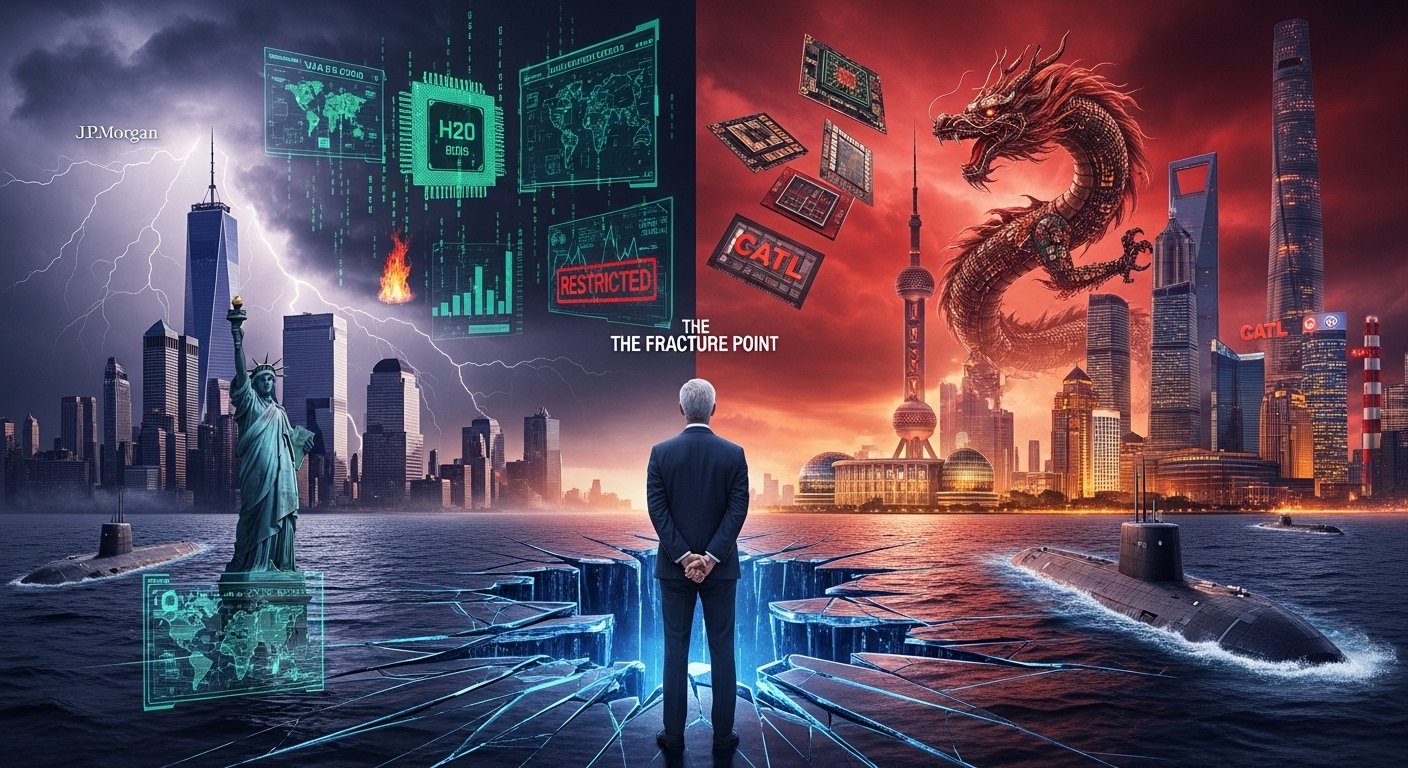
For over two decades, the global financial order operated under a single, unspoken rule: Efficiency over Resilience. But as we sit in early 2026, that era has officially ended. The “Globalism” of the 1990s has been replaced by what many are now calling the Dimon Doctrine—a pragmatic, often brutal assessment of the US-China technology competition that balances Wall Street’s profit mandates against Washington’s national security red lines.
Jamie Dimon, the Chairman and CEO of JPMorgan Chase, has emerged as the most vocal bridge between these two worlds. While his bank continues to underwrite massive deals in the East, his rhetoric in 2025 and early 2026 has taken a sharp, hawkish turn.
In this deep-dive analysis, we break down the specific components of the US-China technology war through the lens of the world’s most influential banker, analyzing the risks of Agentic AI, the CATL IPO fallout, and the “100-Year Tech War” currently being fought in the semiconductor labs of Silicon Valley and Shanghai.
1. The “Embarrassment” List: Identifying America’s Strategic Blind Spots
At the Reagan National Economic Forum in late 2025, Jamie Dimon delivered a speech that sent shockwaves through both the D.C. Beltway and the Shanghai Pudong District. He didn’t just talk about trade deficits; he talked about sovereign vulnerability.
Dimon’s “Embarrassment List” identified four critical areas where the U.S. has lost its technological and industrial edge to China:
The Dependency Matrix
| Sector | Current US Status | The “Dimon” Risk Assessment |
| Pharmaceuticals | 100% Penicillin dependence on China. | A “silent weapon” in a potential conflict. |
| Rare Earth Elements | Over 80% processing controlled by China. | Strategic paralysis for EV and defense manufacturing. |
| Advanced Chipmaking | Heavy reliance on TSMC and ASML tools. | Vulnerability to “supersonic missile” advancements. |
| Energy Storage | CATL dominance (37%+ global market share). | Underwriting the very tech that powers the PLA. |
Dimon’s argument is simple: The U.S. cannot stop China from growing, but it can and must slow them down in areas that define military superiority. This isn’t just about money; it’s about the “things that protect us.”
2. The AI Parabola: Why 2026 is the Year of “Agentic Fear”
If 2023 was the year of the LLM and 2024 was the year of Enterprise AI, 2025 and 2026 have been defined by Agentic AI. During the Davos 2026 World Economic Forum, Dimon described AI not as a “trend,” but as a “parabolic shift” on par with electricity or the internet.
The National Security Conflict
The core of the US-China tech competition now lies in AI Agents—autonomous systems capable of making decisions without human intervention. Dimon’s warning is two-fold:
- Economic Disruption: AI will move “faster than society can adapt,” requiring a massive retraining of the global workforce.
- Military Escalation: Dimon has been a staunch supporter of the Nvidia H20 export restrictions. His logic? “You don’t want to give them the chips which will make their supersonic missiles better.”
The 2025 “Geneva Agreement,” which saw a temporary 90-day tariff reduction and a 10% universal rate, has done little to cool the AI arms race. China continues to push its “Domestic First” policy, summoning Nvidia representatives to explain “security risks” in their H20 chips, while the U.S. Treasury collects a 15% “export tax” on every high-end chip that crosses the Pacific.
3. The CATL Controversy: JPMorgan’s High-Wire Act
Perhaps the most contentious moment in Dimon’s recent tenure was the July 2025 Subpoena from the House Select Committee on the CCP. Chairman John Moolenaar accused JPMorgan of “underwriting genocide” and “aiding the PLA” by participating in the CATL (Contemporary Amperex Technology Co., Limited) IPO.
The Technical Dispute: Section 1260H
CATL has been designated by the Department of Defense as a “Chinese Military Company” under Section 1260H. The Committee argued that:
- CATL batteries are intended to power China’s next-generation submarine fleet.
- The company has deep ties to the Xinjiang Production and Construction Corps (XPCC), a sanctioned entity.
Dimon’s Defense: Despite the political heat, Dimon has maintained a “Business where allowed” stance. In his May 2025 meeting with Chinese Vice Premier He Lifeng, Dimon praised the progress of trade talks, signaling that while he is a hawk on national security, he is a dove on market engagement. This “Dual-Track” strategy is the hallmark of the Dimon Doctrine: Aggressive defense of tech secrets, but aggressive pursuit of capital markets.
4. The 2026 Market Outlook: “Resilience Over Efficiency”
JPMorgan’s 2026 Investment Outlook highlights a permanent shift in global supply chains. The bank is no longer advising clients to “optimize for the lowest cost.” Instead, the focus is on “The Resilience Premium.”

Key Shifts in the Global Tech Stack:
- Near-shoring/Friend-shoring: Moving semiconductor packaging to Mexico and Vietnam.
- The “China + 1” Strategy: Ensuring no single tech component has a 100% dependency on Chinese manufacturing.
- Sovereign AI Clouds: Countries (and corporations) building private, localized AI infrastructures to avoid cross-border data leakage.
Dimon warned in October 2025 that while the U.S. economy remains resilient, the “fragility of the global geopolitical structure” is at its highest point since World War II. High asset prices and persistent deficits are masking a deeper fracture: the world is splitting into two distinct tech-ecosystems.
5. Frequently Asked Questions (FAQ)
Does Jamie Dimon support broad-brush tariffs on China?
No. In late 2025 and early 2026 interviews, Dimon cautioned against “indiscriminate tariffs,” arguing they act as a tax on American consumers. He favors targeted export controls on specific technologies like AI, quantum computing, and advanced semiconductors.
Is JPMorgan withdrawing from the Chinese market in 2026?
On the contrary, JPMorgan has increased its presence in Shanghai, hosting the 21st Annual Global China Summit in May 2025. Dimon’s strategy is “selective engagement”—staying in China for its massive capital market while complying with U.S. national security restrictions.
What is the “100-Year Tech War”?
This is a term popularized in recent shareholder letters. It refers to the idea that the US-China competition is not a temporary trade spat but a century-long struggle for dominance in foundational technologies (Biotech, AI, and Clean Energy).
6. Conclusion: The Strategy for 2026 and Beyond
The US-China technology competition is no longer a peripheral concern for investors; it is the primary driver of market volatility. Jamie Dimon’s approach—half-hawk, half-banker—provides the most realistic roadmap for the years ahead.
Success in 2026 requires recognizing that national security and shareholder value are now inextricably linked. We must stop being “embarrassed” by our dependencies and start building the domestic industrial base required for the AI era.
Next Steps for Global Leaders:
- Audit the Tech Stack: Identify any “100% China” dependencies in your supply chain.
- Invest in AI Agents: Recognize the parabolic shift and move before the competition.
- Monitor the 1260H List: Ensure your institutional investments aren’t inadvertently funding the military-industrial complex of a strategic rival.