
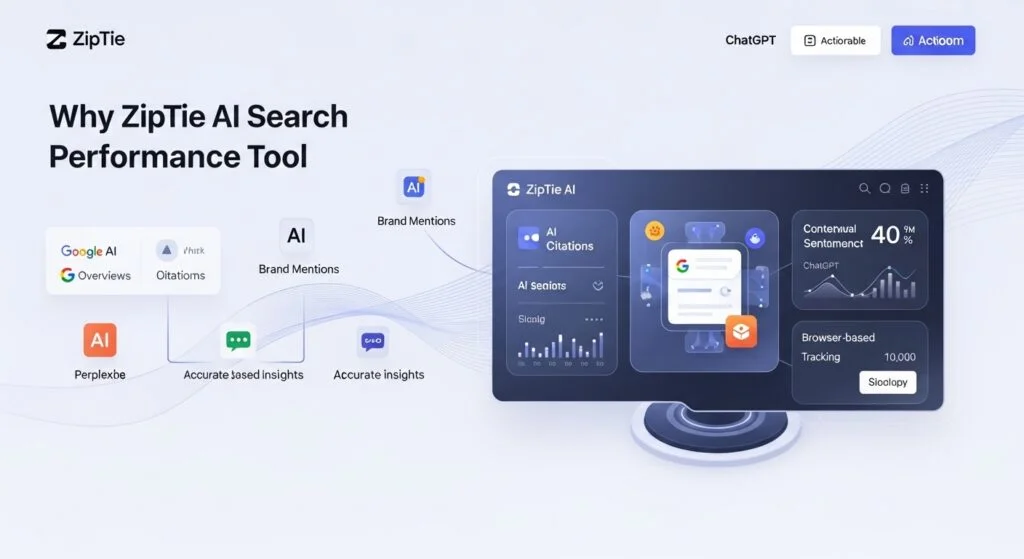
The digital ecosystem of 2026 has transitioned from a period of experimental adaptation to a settled reality of generative dominance. The search landscape, which for decades relied upon the mechanical indexing of web pages and the subsequent presentation of “blue links,” has fundamentally inverted. In this new paradigm, artificial intelligence serves not merely as a facilitator of search but as the primary curator and synthesizer of information. This shift, colloquially termed the “Click Collapse,” represents a critical juncture where Gartner’s 2025 prediction—that AI search would capture $25\%$ of the traditional search market—has materialized as a conservative estimate.1 The emergence of zero-click search as the default user experience means that brand visibility is no longer a matter of being ranked but of being cited, mentioned, and trusted within the synthesized responses of Large Language Models (LLMs).2
In this environment, the ZipTie AI Search Performance Tool has surfaced as a pivotal architectural solution for enterprise marketing teams and SEO agencies. Unlike traditional monitoring software that retrofits legacy keyword tracking for the AI era, ZipTie was engineered from a technical SEO heritage specifically to navigate the non-deterministic nature of generative engines.4 The necessity of such a tool is underscored by the fundamental differences between Search Engine Optimization (SEO) and the emerging discipline of Generative Engine Optimization (GEO). While the former prioritized clicks and session duration, the latter focuses on “Answer Inclusion Rates” and “Share of Influence”.2 The following analysis provides an exhaustive review of ZipTie’s technical capabilities, strategic importance, and its role as a bridge between measurement and performance improvement in the 2026 search economy.
| Evolution of Digital Visibility Metrics | Traditional SEO Era (Pre-2024) | Generative Search Era (2025-2027) |
| Primary Interaction | Link Scanned & Clicked | Answer Consumed & Cited |
| Visibility Model | Page-Level Ranking | Passage-Level Extraction |
| Primary Metric | Organic Position (1-10) | AI Success Score (Mentions, Citations, Sentiment) |
| Core Technical Goal | Crawlability & Indexing | RAG Ingestion & Entity Clarity |
| Competitive Landscape | Keyword Competitors | Source/Narrative Competitors |
The Genesis and Technical Philosophy of ZipTie AI
The efficacy of ZipTie is rooted in its origin as a project of Onely, a premier technical SEO agency known for its deep research into indexing and machine learning.4 The founders—Tomasz Rudzki, Bartosz Góralewicz, and Sebastian Skowron—recognized early that traditional rank tracking was becoming a “vanity metric” that failed to explain why traffic patterns were shifting despite stable keyword rankings.4 This realization led to a strategic pivot two years ago, refocusing the entire platform toward a $100\%$ AI-centric monitoring and optimization model.5
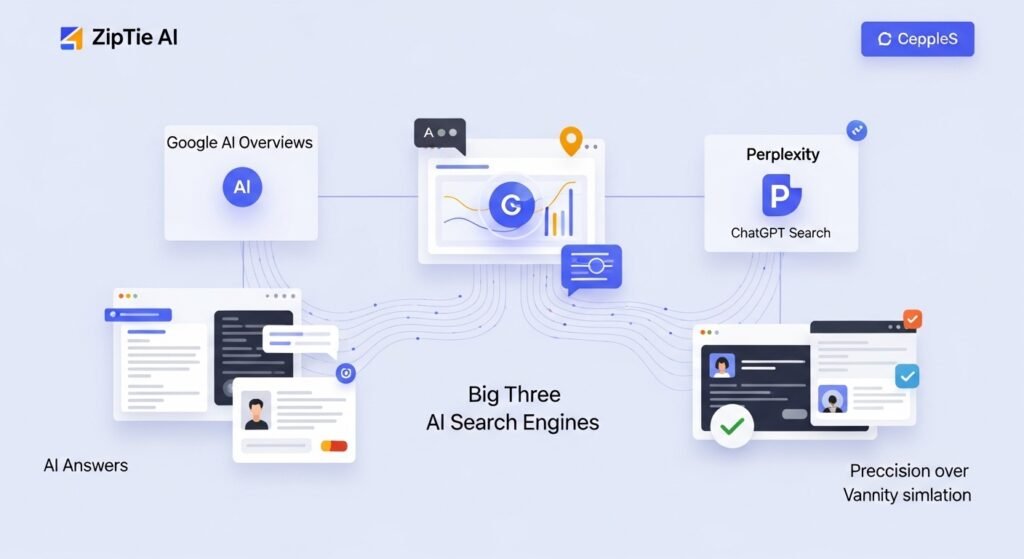
The technical philosophy of ZipTie prioritizes “accuracy over convenience.” Many competitive tools rely on simplistic API calls to LLM providers, which can return sanitized or “cached” results that do not reflect what an actual user sees in their specific geographic and contextual environment.4 ZipTie, by contrast, utilizes real browser-based tracking technology. This approach simulates authentic user sessions across diverse platforms, allowing the tool to capture the exact text of AI responses, downloadable screenshots for auditing, and the full set of citations provided by the engine.4 This methodology is critical because AI search results are non-deterministic; they vary by login state, location, and the specific nuances of the prompt provided.11
Architectural Focus: The “Big Three” Hegemony
While the AI market is increasingly fragmented with specialized models like Claude, Grok, and DeepSeek, ZipTie maintains a strategic focus on the platforms that drive the highest commercial impact: Google AI Overviews, ChatGPT Search, and Perplexity.1 This focus allows for deeper analysis of the specific ingestion pipelines of these engines. Google AI Overviews are prioritized due to Google’s continued $90\%$ market coverage, where AI-generated summaries now appear at the top of the majority of commercial queries.1 ChatGPT Search is monitored as a rapidly growing destination for conversational research, while Perplexity is tracked for its role as a high-authority “answer engine” that emphasizes verified source linking.4
The AI Success Score: A New Standard for Brand Attribution
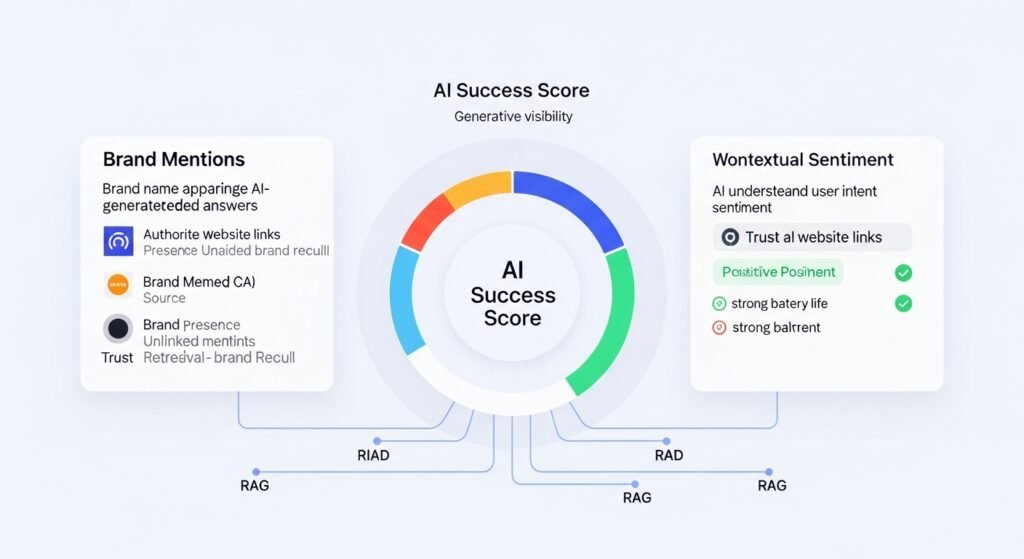
The central innovation of the ZipTie platform is the AI Success Score. This proprietary metric serves as a single, clear indicator of a brand’s performance across generative surfaces, synthesizing complex data points into an actionable benchmark.13 The score is calculated based on three fundamental pillars of generative visibility: brand mentions, website citations, and contextual sentiment.
Pillar 1: Brand Mentions as a Metric of Presence
In a world where users may never click through to a website, the mention of a brand within an AI answer becomes the new unit of impression. A mention signifies that the brand is part of the “candidate pool” that the AI model considers relevant for a specific query.2 ZipTie identifies these mentions even when they are not linked, providing insight into “Unaided Brand Recall” across LLMs.17 The platform distinguishes between “Mention Leaders” and “Citation Leaders,” helping teams understand if their problem is one of brand awareness or authoritative linkability.1
Pillar 2: Website Citations and RAG Eligibility
A citation occurs when an AI engine explicitly links to a domain as a source of truth. In the framework of Retrieval-Augmented Generation (RAG), citations are the ultimate proof of authority.2 ZipTie tracks citation frequency and “Citation Drift”—the stability of a brand’s presence in an AI response over time.1 This metric is vital because being cited in an AI Overview or a ChatGPT response provides a direct pathway for users to verify information and move deeper into the conversion funnel.1
Pillar 3: Contextual Sentiment Analysis
Generic sentiment analysis often fails to capture the nuances of AI-generated reviews or comparisons. ZipTie employs an advanced “Contextual Sentiment” model that analyzes brand portrayal based on what the user actually cares about in a specific prompt.1 For instance, if a user queries the “battery life” of a smartphone, and the AI response mentions that the phone has a “weak camera but a perfect battery,” ZipTie correctly identifies the sentiment as positive relative to the user’s intent, whereas a basic tool might flag the overall response as neutral or negative.1
| Metrics Captured by the AI Success Score |
| Data Point |
| Brand Mentions |
| Source Citations |
| Sentiment Analysis |
| AI Success Score |
The Content Optimization Module: Closing the Actionability Gap
The primary criticism of first-generation AI visibility tools was their lack of actionability; they could report a lack of visibility but could not prescribe a remedy.11 ZipTie addresses this “implementation gap” through its built-in Content Optimization Module.1 This module represents a transition from “passive monitoring” to “active improvement,” analyzing the delta between a brand’s content and the content currently being cited by AI engines for the same target prompts.5
Theoretical Framework: Designing for Machine Ingestion
Success in GEO requires content that is optimized for “machine ingestion.” The Content Optimization Module examines existing web pages to identify structural and semantic gaps that prevent AI agents from extraction.2 It detects whether a page follows the “Answer-First” structure, uses modular passage-level design, and adheres to the granular formatting rules that facilitate parsing.2 Instead of suggesting generic keyword stuffing, ZipTie provides specific recommendations such as “add a direct comparison table” or “provide a concise $40-60$ word summary of this feature”.5
Content Gap Analysis and E-E-A-T Scoring
The platform’s optimization report is categorized into five key areas: Trustworthiness, Authority, Freshness, Originality, and Comprehensiveness.22 This alignment with Google’s E-E-A-T criteria ensures that the content meets the high thresholds required for AI citation. For example, if an AI Overview pulls from sources that cite first-hand experimental data, and the brand’s page only provides general summaries, ZipTie will flag a “Comprehensiveness” gap and suggest adding original insights or case studies.18
Systematic Step-by-Step Optimization Process
ZipTie defines a clear workflow for troubleshooting visibility issues, moving from diagnostic data to implementation:
- Target Query Selection: Users identify high-value commercial prompts, such as “is good for beginners?” or “best [Product Category] for [Use Case]”.12
- Content Submission: The actual text of the article or product page is submitted to the analyzer. This is a critical distinction, as ZipTie analyzes the “raw material” provided to the AI rather than just the URL.22
- Actionable Feedback: The tool generates an optimization report that highlights missing entities, thin explanations, and weak evidence sections. It provides AI-generated suggestions for filling these gaps, allowing editors to update content that specifically targets the model’s retrieval requirements.21
Competitive Intelligence: Navigating the Hidden Landscape
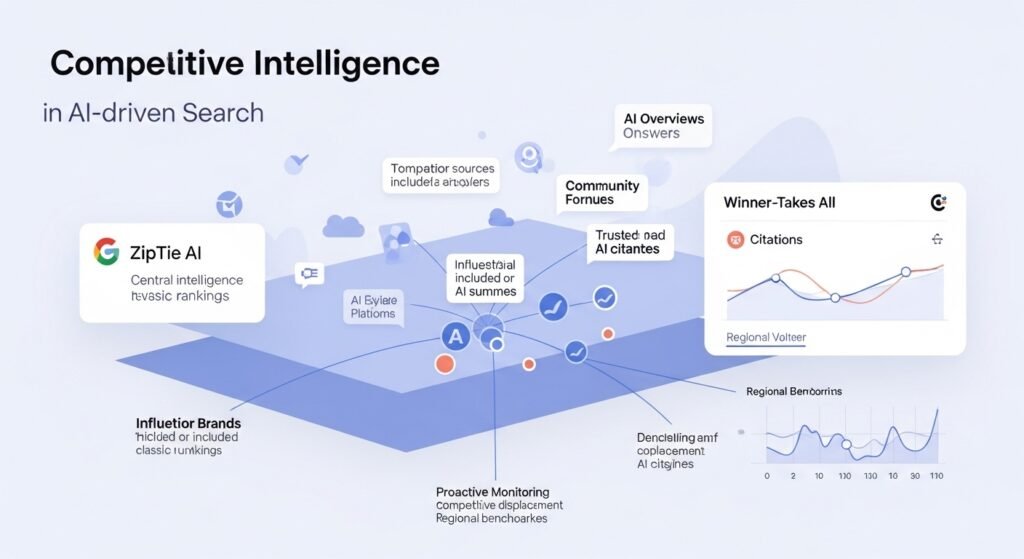
In the generative era, competition is no longer confined to the traditional SERP rankings. A brand may rank number one in organic results but be completely omitted from the AI Overview summary if a competitor’s content is more “answer-ready”.6 ZipTie’s competition analysis tools are designed to surface these “hidden” threats and opportunities.
Identifying Influential Sources and Third-Party Citations
A key strategic insight offered by ZipTie is the identification of “Most Influential Sources”.1 Often, an AI engine will not cite a brand’s website directly but will instead cite a review site like G2, a community thread on Reddit, or a news article from a trusted publication.24 ZipTie allows brands to identify these “intermediaries.” If a competitor is winning a disproportionate share of voice because they are consistently mentioned in a specific Zapier comparison article that the AI trusts, the strategic recommendation is for the brand to pursue an inclusion in that third-party source.11 This “indirect optimization” is essential for long-term brand authority.26
Benchmarking against AI-Driven “Winner-Takes-All” Markets
Generative engines tend to favor a small cluster of highly consistent sources, potentially creating “Winner-Takes-All” scenarios in certain niches.3 ZipTie’s historical trend analysis allows teams to monitor if their share of influence is decaying or if a new entrant is rapidly capturing AI citations.1 By tracking “Competitive Displacement,” agencies can proactively adjust their strategies before a decline in AI visibility translates into a catastrophic drop in traffic.29
| Competitive Intelligence Capabilities |
| Feature |
| Influential URL Tracking |
| Competitor Citation Mapping |
| Historical Trend Analysis |
| Regional Benchmarking |
Technical Implementation and Operational Scalability
The adoption of ZipTie by large-scale agencies like Seer Interactive underscores its capacity for enterprise deployment.4 Managing SEO across traditional search and multiple AI platforms is an immensely complex task that manual oversight cannot sustain. ZipTie provides the automation necessary to scale these efforts.5
Flexible Query Generation and GSC Integration
One of the primary friction points in AI search monitoring is defining what prompts to track. Traditional keywords are often too short and do not match the conversational queries users provide to AI engines.9 ZipTie solves this through a flexible query generator that offers three methods of list building:
- AI-Assistant Generator: Analyzes a brand’s URL (homepage, blog, or product page) to discover relevant conversational queries potential customers are using.1
- Google Search Console Integration: Imports keywords for which the brand is already ranking, allowing teams to see which of their current “top” keywords are triggering AI Overviews.13
- Custom Query Manually: Allows for the manual input of specific high-priority prompts or competitor-branded searches.13
The Importance of Browser-Based Multi-Region Tracking
AI search results are geographically sensitive. A query for “best business banking” in the US will yield different results than the same query in the UK or India.11 ZipTie explicitly supports multi-geo tracking across 14 countries, including the US, UK, India, Canada, Australia, and Spain.10 This capability is a deciding factor for multinational brands that need to verify their global visibility. Without location-aware checks, AI visibility data can be dangerously misleading.11
Data Export and Reporting Workflow
While ZipTie does not currently offer a public API, its robust CSV export functionality is designed for “Export-First” organizations.1 The exports include the full text of AI responses, detailed sentiment breakdowns, and comprehensive source lists.1 This allows teams to integrate ZipTie data into BI tools like Looker Studio or custom reporting dashboards, providing a visual and concrete narrative for leadership and clients.6
Economic Justification and ROI of ZipTie AI
The shift to generative search represents an existential threat to traffic-dependent business models. As AI-generated summaries reduce organic web clicks by an estimated $15-25\%$, the ROI of marketing spend must be reevaluated.32 ZipTie provides the data points necessary to bridge this transition.
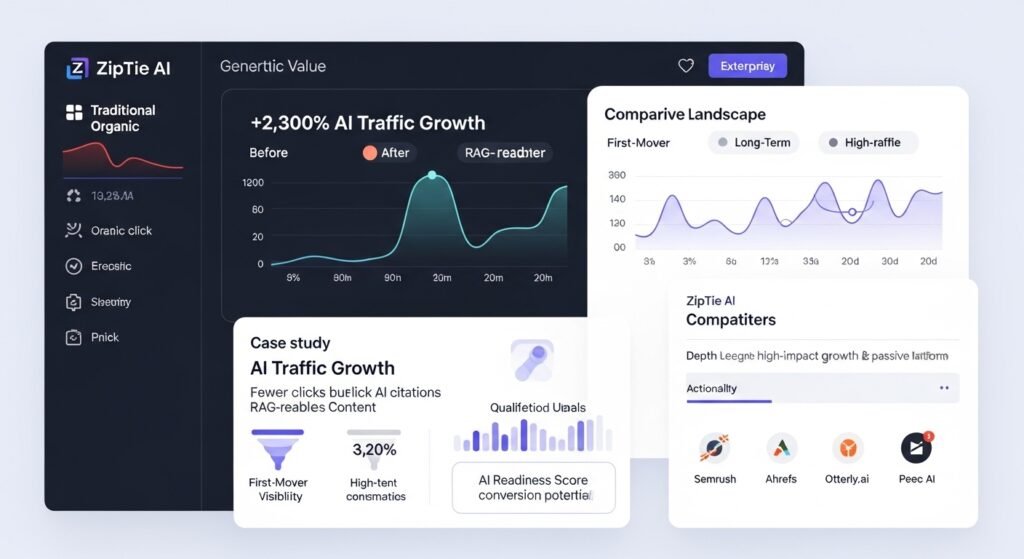
The 2,300% Growth Case Study
Evidence of the platform’s impact is found in a case study of an industrial products manufacturer.34 Despite a strong traditional SEO presence, the brand was initially “invisible” in AI search results. By utilizing ZipTie to identify content gaps and optimizing for “RAG-readability” (modular text, clear headings, and direct answers), the brand achieved a $2,300\%$ jump in traffic from AI platforms.34 This demonstrates that the “first-mover advantage” in GEO can lead to entrenched dominance as AI models begin to rely on a consistent set of trusted sources.3
Conversion Quality and “Answer-First” Visibility
A critical takeaway for 2026 is that while total click volume may decrease, the quality of the remaining traffic is often higher. Users who interact with an AI summary and still choose to click a citation are “pre-qualified” leads who have already synthesized the core information.19 ZipTie helps brands capture these high-intent users by ensuring they are the “recommended” solution in the summary. The platform’s “AI Readiness Score” provides a single metric that translates this complex visibility into a benchmark that correlates with conversion potential.5
| ZipTie AI Pricing and Service Tiers (Monthly) |
| Plan Tier |
| Basic |
| Standard |
| Pro |
Note: Plans also include URL indexing checks ranging from $10,000$ to $100,000$ per month.4
Comparative Analysis: ZipTie vs. the Competitor Landscape
The market for AI search monitoring has expanded rapidly, yet ZipTie remains a “mid-range tracker” that offers a specialized blend of technical depth and operational ease.4 The following comparison highlights how ZipTie differentiates itself from generalist SEO suites and other GEO specialists.
ZipTie vs. Legacy SEO Platforms (Semrush, Ahrefs)
Semrush and Ahrefs have introduced AI visibility toolkits that integrate with their existing data ecosystems.37 The advantage of these tools is their “unified search intelligence” workflow—AI visibility sits alongside keyword research and backlink analysis.38 However, ZipTie’s specialized focus allows for deeper analysis of the content of the AI response.4 ZipTie is often used as a “surgical” tool by specialists who find that the broader suites lack the granular sentiment and “Influential Source” tracking needed for high-stakes optimization.1
ZipTie vs. Enterprise Specialists (Profound)
Profound is positioned as the “Enterprise Powerhouse,” offering coverage of $10+$ platforms and hourly update frequencies.5 While Profound is excellent for Fortune 100 brands requiring massive scale and SOC 2 Type II compliance, its pricing (often starting at $\$4,000+/mo$ for custom plans) is prohibitive for mid-market teams.5 ZipTie offers a comparable “visibility-to-action” workflow at a fraction of the cost, making it the preferred choice for teams that need to operationalize GEO without an enterprise-only budget.5
ZipTie vs. Emerging Monitoring Tools (Otterly.ai, Peec AI)
Otterly.ai and Peec AI are recognized for their affordability and ease of setup, making them accessible entry points for freelancers.38 While they excel at reporting “share of voice,” they often fall short in providing the strategic guidance necessary to change a brand’s standing.20 ZipTie’s Content Optimization Module distinguishes it as a “growth tool” rather than a passive monitor, closing the implementation loop that frustrates users of lighter tools.7
| AI Search Visibility Tool Matrix (2026 Perspective) |
| Platform |
| ZipTie AI |
| Profound |
| Otterly.AI |
| Peec AI |
| Semrush AI |
Technical Challenges and Strategic Countermeasures
Operating in the generative search space involves navigating an “arms race” between search engines and monitoring tools. ZipTie’s founders have been vocal about the technical challenges inherent in this field, particularly regarding Google’s evolving defenses.4
Smart-Blocking and Detection Rates
Recent “smart-blocking” measures implemented by Google have occasionally impacted detection rates for automated trackers.4 ZipTie actively tackles this by using advanced real-browser technology that mimics authentic user behavior to bypass bot-detection signals.6 This ensures that the data collected remains representative of the true user experience, which is essential for maintaining client trust.4
Non-Deterministic Logic and Hallucination Risk
Because LLMs are non-deterministic, they can generate factual errors or “hallucinations” about a brand.16 ZipTie’s recording of full AI response text provides a critical audit trail for PR and legal teams.17 By identifying hallucinated links or incorrect data, brands can trace the “incorrect” signal back to its source—often a low-authority directory or an outdated blog post—and take corrective action to “re-seed” the AI’s knowledge base with accurate information.22
JavaScript and “Shadowbanning”
A common technical barrier identified by ZipTie is the impact of JavaScript rendering on AI visibility. AI agents often struggle to parse content that is heavily dependent on client-side JavaScript, leading to “low ChatGPT scores” even for sites that rank well in traditional Google search.15 Furthermore, some engines may display AI Overviews to real users while suppressing them for known “bots,” a phenomenon sometimes referred to as “shadowbanning” the AI answer.9 ZipTie’s use of incognito-style, non-personalized browsers is designed to overcome these discrepancies and provide a “clean” view of visibility.8
Expert Perspectives and Professional Endorsements
The credibility of ZipTie is bolstered by endorsements from some of the search industry’s most respected practitioners. Their testimonials highlight the tool’s role in a modern SEO stack.
Aleyda Solis: Monitoring the Early Rollout
Aleyda Solis has emphasized ZipTie’s essential role in tracking AI Overviews during their early global rollout.12 She recommends the tool for “spotting which organic keywords generate AI Overviews,” an insight that allows agencies to refine their content strategy to stay ahead of traffic shifts.4
Lily Ray: Managing Health and Trust-Sensitive Queries
Lily Ray, an expert in E-E-A-T and medical-related SEO, calls ZipTie her “go-to tool to monitor client inclusion in AI Overviews”.4 She praises the platform’s accuracy and ease of use in sensitive sectors where the “Consensus Check”—ensuring that AI answers align with verified medical or legal facts—is paramount.4
Kevin Indig: The Indexing-Visibility Link
Kevin Indig highlights two critical data points that ZipTie covers which are rarely found together: site indexing and AI Overviews.12 His perspective is that “without being indexed, you cannot rank; without monitoring AI Overviews, you cannot tap into opportunities”.12 This underscores the platform’s dual value as both a technical hygiene tool and a generative visibility tracker.
Conclusion: The Imperative for ZipTie in a Post-Click Economy
The search paradigm of 2026 is one defined by synthesis rather than just selection. In this environment, the traditional metrics of search marketing—rankings, traffic volume, and backlinks—tell only a fraction of the story. The true indicator of brand health is now found within the synthesized answers of Google, ChatGPT, and Perplexity. ZipTie AI has established itself as the indispensable platform for this new reality, providing a verifiable, actionable framework for brand survival and growth.6
Choosing ZipTie is a strategic decision to move beyond “expensive dashboarding” toward a systematic process of optimization.9 By focusing on the core signals of mentions, citations, and sentiment, and providing the built-in Content Optimization Module to bridge the implementation gap, ZipTie allows marketing teams to transition from guessing to knowing.1 As AI search continues to evolve into agentic and multimodal experiences, the organizations that leverage ZipTie’s technical depth and first-mover expertise will be the ones that secure their position as the “trusted sources” of the generative future.3 The 2026 search economy rewards authority, clarity, and precision—all of which are the fundamental outputs of the ZipTie AI Search Performance Tool.11
FAQ’S
ZipTie AI is a cutting-edge search performance tool that tracks and optimizes your visibility across AI-driven platforms like Google AI Overviews, ChatGPT, and Perplexity.
Unlike traditional SEO tools, ZipTie uses real browser-based tracking to capture actual AI-generated responses, brand mentions, citations, and contextual sentiment—offering deeper, actionable insights
Digital marketers, SEO specialists, and brands looking to optimize their presence in AI search results and capture high-intent traffic should use ZipTie AI.
By identifying content gaps, tracking AI citations, and optimizing for answer-ready content, ZipTie ensures high-quality, pre-qualified traffic, boosting conversions and marketing ROI.