
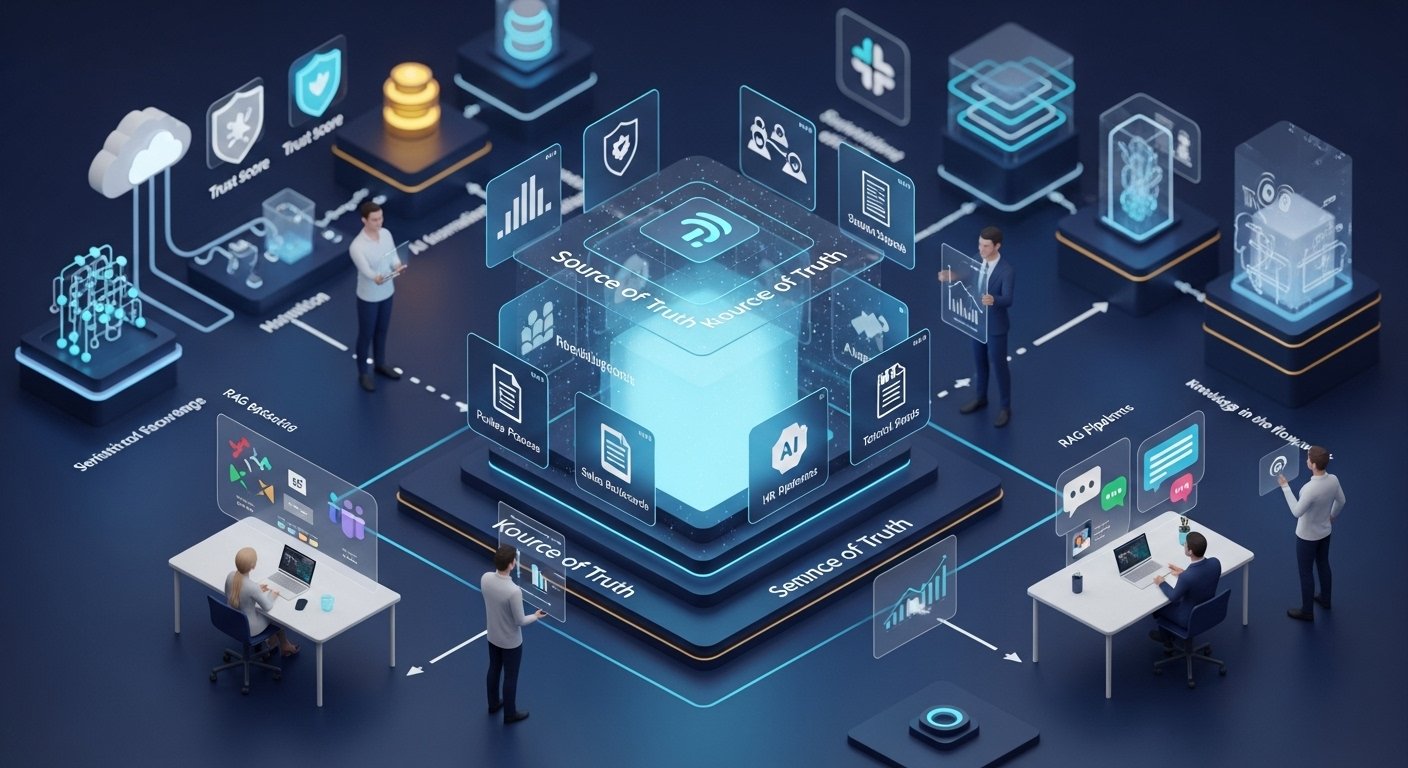
The modern enterprise is currently navigating a period of profound transformation regarding how institutional knowledge is captured, verified, and distributed. As organizations scale, they inevitably encounter the “information tax”—a phenomenon where the proliferation of tools, chat platforms, and document repositories creates a fragmented landscape that hampers productivity. Within this context, Guru has emerged as a specialized knowledge management platform designed to serve as an AI-powered “Source of Truth,” moving away from the traditional model of static wikis toward a proactive, contextual system that delivers information exactly where work occurs. This analysis explores the technical architecture, strategic implementation, and evolving role of Guru within the 2025–2026 technological landscape.
The Evolution of Workplace Intelligence and the Information Tax
The necessity for advanced knowledge management software like Guru is driven by the increasing complexity of the digital workspace. Research indicates that the average employee spends a significant portion of their workday searching for information or recreating existing work, a burden that scales linearly with the size of the organization. This “information tax” is not merely a technical issue but a cultural and psychological one, leading to increased context switching, decision fatigue, and a reliance on “shoulder-tapping” subject matter experts (SMEs).
Traditional knowledge bases often fail because they are “pull” systems—they require the user to leave their current task, navigate to a separate portal, and attempt to find information that may or may not be up to date. Guru’s philosophy is built on the premise of “push” knowledge, where verified information finds the user in the apps they already use, such as Slack, Microsoft Teams, and various CRM platforms. By integrating into the flow of work, the platform aims to reduce the cognitive load associated with information retrieval, effectively serving as an augmented memory for the entire organization.
Core Architecture: The Modular Knowledge Unit
At the heart of Guru is a departure from the traditional document-centric approach to knowledge. Instead of long-form articles or multi-page wikis, Guru utilizes “Cards” as its primary content unit. This modular structure is designed to reflect how humans actually consume and share information in a fast-paced environment. Each Card represents a single, focused topic—a policy, a troubleshooting step, a competitor battlecard, or a specific process update.
Cards, Collections, and Folders
The hierarchy of information in Guru is designed to balance structured organization with the flexibility needed for rapid updates.
- Cards: These are the atomic units of knowledge. They support rich text, media, and attachments, but their strength lies in their focus. By breaking knowledge into digestible pieces, Guru makes it easier to update individual components of a process without needing to revise a massive document.
- Folders: Cards are grouped into folders, which allow for a logical categorization of related topics. Folders can be nested, providing a familiar hierarchy for users accustomed to traditional file systems.
- Collections: These are the highest level of organization, often aligned with specific departments or functional areas, such as “Sales Enablement,” “HR Policies,” or “Engineering Best Practices”.
This modularity is essential for the platform’s AI capabilities. When a user asks a question, the AI can retrieve the specific Card that contains the answer, rather than pointing the user to a 50-page PDF and leaving them to find the relevant section.
| Architectural Component | Function | Strategic Benefit |
| Knowledge Cards | Single-topic content units | Reduces cognitive load; simplifies updates |
| Collections | Departmental or functional silos | Manages permissions and focuses ownership |
| Folders | Hierarchical grouping | Provides a familiar navigation structure |
| Trust Score | Metric based on verification status | Quantifies the reliability of the knowledge base |
Artificial Intelligence and Retrieval-Augmented Generation (RAG)
As of 2026, Guru’s competitive advantage is deeply rooted in its application of generative AI, specifically through a model known as Retrieval-Augmented Generation (RAG). Traditional AI models are often prone to “hallucinations”—generating confident but incorrect answers because they are drawing from a general pool of internet data. RAG solves this by grounding the AI in the organization’s own verified content.
Semantic Search and Intent Matching
Guru’s search engine has evolved beyond simple keyword matching. By utilizing Natural Language Processing (NLP), the system can understand the intent behind a query. If an employee searches for “how do I get my money back from a customer,” the system recognizes the intent as a “refund process,” even if the Card is titled “Customer Reimbursement Protocols”.
This semantic understanding is a cornerstone of the 2026 updates. The global NLP market, projected to reach $156.80 billion by 2030, is fueling these advancements, allowing for multilingual support and context-aware queries that can parse slang or shorthand used by specific teams.
Knowledge Agents and Automatic Quality Maintenance
In 2026, the introduction of “Knowledge Agents” has shifted the paradigm from passive search to active maintenance. These agents do not just retrieve information; they actively monitor the quality of the knowledge base. They can automatically verify or unverify content across multiple sources—including Google Drive, Confluence, and SharePoint—based on usage signals and engagement patterns.
For example, if a Knowledge Agent detects that a Card regarding a specific software version is no longer being accessed after a new version update, it may flag the content for review or auto-archive it to keep the search results clean. This automation is critical for maintaining a “high-trust” environment, as it prevents the accumulation of “knowledge debt”—the lingering presence of outdated or redundant information.
The Verification Engine: Building Institutional Trust
The single most important differentiator for Guru is its human-in-the-loop verification workflow. In most knowledge management systems, documentation becomes stale because there is no accountability for its accuracy. Guru addresses this by requiring every Card to have an assigned “Verifier”—usually a Subject Matter Expert (SME) or a specific group responsible for that topic.
The Verification Lifecycle
The verification process creates a clear audit trail and ensures that the information being served to employees (and potentially customers) is accurate.
- Assignment: When a Card is created, it is assigned to a verifier. AI can suggest the best verifier based on who created the content or who has historically updated similar topics.
- Scheduling: A verification interval is set (e.g., every 90 days). For evergreen content, a “never expire” option is available, although Knowledge Agents can still override this if they detect usage patterns suggesting the information is no longer relevant.
- Notification: As the deadline approaches, Guru sends notifications via Slack, email, or the web app. Verifiers can see their tasks in a centralized “My Tasks” dashboard.
- Action: The verifier reviews the Card. If it is still accurate, they verify it with one click. If it needs updates, they edit and save the Card, which automatically re-verifies it.
This system creates a “Trust Score” for each collection. A high trust score signals to the team that they can act on the information with confidence, significantly reducing the “should I double-check this?” cycle that plagues most organizations.
Integrating Knowledge into the Flow of Work
The effectiveness of a knowledge base is directly proportional to its accessibility. Guru’s strategy focuses on meeting users where they already spend their time, reducing the friction of context switching—the act of jumping between different applications to find an answer.
The Browser Extension: Contextual Overlays
The Guru browser extension acts as a “heads-up display” for the web. It overlays a search bar and suggested content on top of any website or web-based application, such as Salesforce, Zendesk, or internal portals.
- Knowledge Triggers: Admins can set “triggers” that automatically surface specific Cards based on the URL or specific keywords on a page. If a customer support agent is on a page related to “billing disputes,” the extension can automatically suggest the Card for “Refund Processing”.
- Knowledge Clipper: This feature allows users to capture information from any webpage and instantly turn it into a Card. A product manager reading a competitor’s blog post can highlight a key feature and clip it directly into the “Competitive Intelligence” collection.
Slack and Microsoft Teams: Real-Time Q&A
For organizations using Slack or Microsoft Teams as their primary communication channel, Guru’s integration transforms these platforms into active knowledge hubs. In 2026, AI Knowledge Agents can provide direct, cited answers to questions asked within a channel.
In Slack, users can simply mention @guru or ask a question naturally. The AI bot analyzes the request, searches the verified knowledge base (including connected external sources like Google Drive), and provides an answer with links to the source Cards. This drastically reduces the number of repetitive questions asked in public channels, as the bot can answer them instantly using the company’s own “Source of Truth”.
Strategic Use Cases and ROI Analysis
The return on investment (ROI) for Guru is measured not just in time saved, but in increased accuracy, faster onboarding, and improved employee confidence. The impact is felt most acutely in departments with high knowledge-density requirements.
Customer Support and Success
In customer support, the metrics are clear: first-call resolution (FCR) rates and average handle time (AHT). By providing agents with instant access to verified troubleshooting guides and product scripts, Guru helps them resolve issues faster and with greater consistency.
AI-powered knowledge bases also enable customer self-service. By mirroring internal knowledge Cards to a public-facing help center, companies can empower customers to find their own answers, which can reduce support ticket volume by up to 50%.
Sales Enablement and Competitive Intelligence
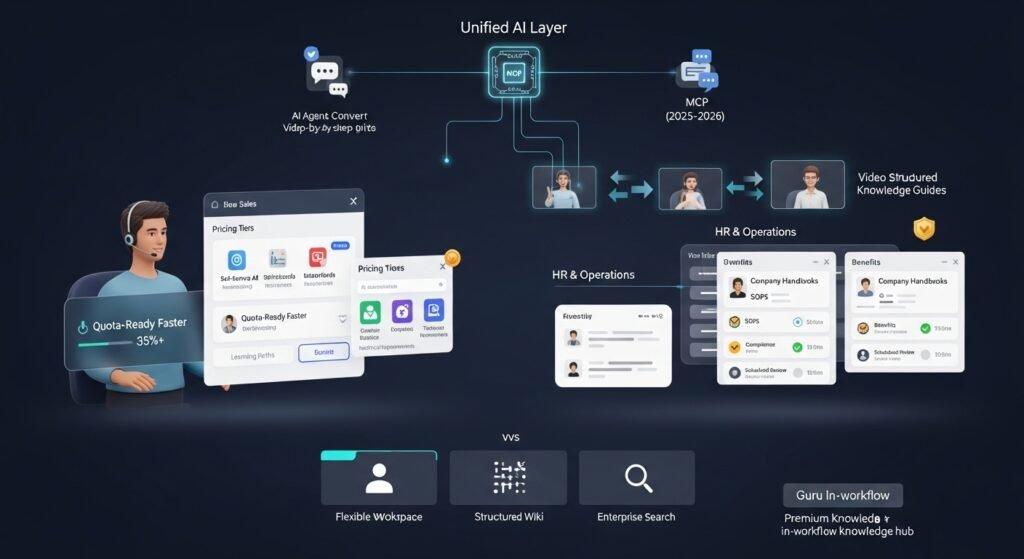
Sales teams must stay updated on product changes, pricing models, and competitor moves. Guru serves as a real-time repository for sales collateral and battlecards. During a live sales call, a rep can use the browser extension to pull up specific pricing tiers or technical requirements without having to say, “Let me check and get back to you”.
Furthermore, research indicates that Guru can reduce new hire onboarding time by over 35%. By giving new reps a self-service path to all the information they need, companies can get them “quota-ready” significantly faster than traditional training models.
HR Policy and Operations
For HR and Operations, Guru acts as the official repository for company handbooks, benefits information, and standard operating procedures (SOPs). The verification workflow is particularly valuable here, ensuring that legal and compliance documents are reviewed on a strict schedule.
| Department | Primary Use Case | Measurable ROI |
| Customer Support | Troubleshooting guides; FAQs | Higher FCR; Lower AHT |
| Sales | Battlecards; Pricing; Collateral | 35%+ reduction in onboarding time |
| HR / Ops | Handbooks; SOPs; Benefits | Audit-ready compliance; Lower internal support load |
| Engineering | Technical specs; Onboarding | Reduced “knowledge debt”; Faster dev ramp-up |
2025–2026 Technological Frontier: Beyond the Card
The 2026 landscape for knowledge management is defined by the integration of AI agents into the very fabric of content creation. The market has shifted from “make it searchable” to “make it actionable”.
Automated Content Generation from Multimedia
One of the most significant advancements in 2026 is the ability to capture knowledge from video and audio. Instead of requiring a Subject Matter Expert to write a manual, they can simply record their screen while performing a task and talk through the process. AI tools can now analyze that video, extract the key steps, and automatically generate a polished, step-by-step Card with screenshots.
This “Video-to-Guide” conversion addresses the primary bottleneck in knowledge management: the time required to document expertise. By lowering the barrier to entry, companies can capture “tacit knowledge”—the skills and experiences that usually stay in an employee’s head.
The MCP (Model Context Protocol) Integration
Guru has introduced support for the Model Context Protocol (MCP), allowing its knowledge base to power other AI tools, such as ChatGPT or Claude. By connecting Guru’s MCP server to these models, employees can use general-purpose AI interfaces to query their company’s specific, verified data. This creates a “Unified AI Layer” where the organization’s intelligence is accessible through any conversational interface the employee prefers.
Market Landscape: A Comparative Analysis
While Guru is a leader in “in-workflow” knowledge, it competes with a diverse set of tools, each with its own strengths and weaknesses. The choice between them often depends on the organization’s existing tech stack and the primary “pain points” they are trying to solve.
Guru vs. Notion
Notion is highly favored for its flexibility and “all-in-one” workspace feel. It is excellent for project management and creating beautiful, long-form documents. However, Notion’s flexibility is also its risk factor; without strict governance, it can lead to “knowledge sprawl”. Unlike Guru, Notion does not have a native, scheduled verification engine that forces experts to review content periodically, making it less suitable for high-compliance industries.
Guru vs. Confluence
Confluence remains the standard for engineering and product teams deeply embedded in the Atlassian ecosystem (Jira, Bitbucket). Its page-tree hierarchy is ideal for formal technical documentation and DevOps workflows. However, Guru is often seen as more user-friendly for non-technical departments like Sales or HR, and its browser extension provides a more seamless “flow of work” experience than Confluence’s more portal-focused interface.
Guru vs. Bloomfire
Bloomfire focuses heavily on “Enterprise Search” and is often used by large organizations to search across vast, disconnected datasets. It is particularly strong in multimedia search (finding specific moments in video). While Guru is catching up in this area with its Knowledge Agents, Bloomfire is often viewed as a more robust choice for pure research-heavy organizations.
| Platform | Primary Differentiator | Best For |
| Guru | Verification & Workflow Overlay | Sales Enablement, Support, HR |
| Notion | Flexibility & Databases | Startups, Creative Teams |
| Confluence | Jira Integration & Hierarchy | Engineering, DevOps, IT |
| Bloomfire | Enterprise Search & Media | Large Scale Knowledge Retrieval |
| ClickUp | PM + Knowledge Integration | Task-heavy, cross-functional teams |
Implementation Strategy: The 90-Day Roadmap
The failure of most knowledge management initiatives is due to poor change management rather than technical limitations. To succeed, organizations must treat Guru as a cultural shift, not just a software installation.
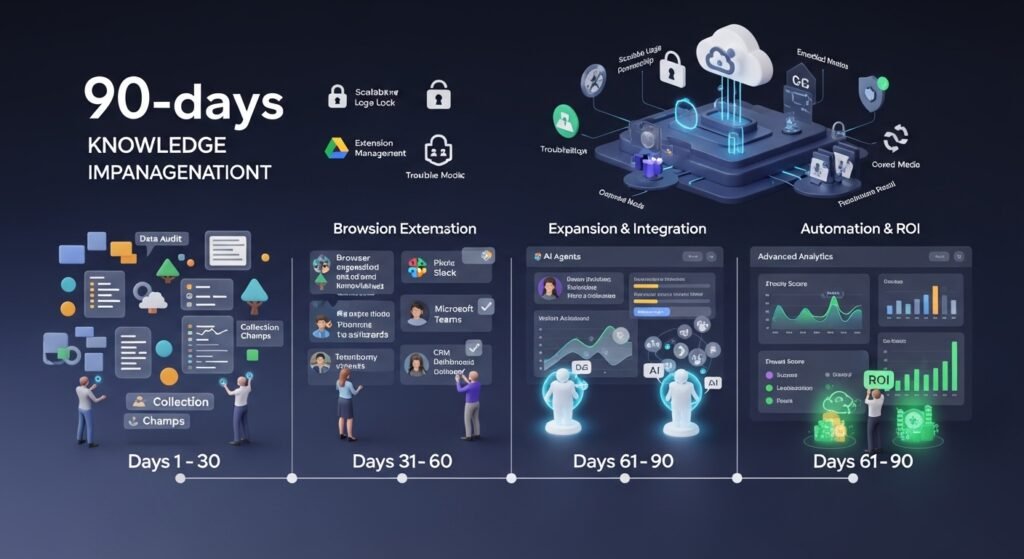
Phase 1: The Foundation (Days 1–30)
The first 30 days are about identifying the “low-hanging fruit.” Organizations should start with a single team or a single high-impact collection, such as “New Hire Onboarding”.
- Select Collection Champs: These are the internal influencers and SMEs who will set the tone for the knowledge philosophy. They are responsible for the initial structure and for encouraging adoption within their teams.
- Audit and Preprocess Data: Before importing data, it must be cleaned. Information that is outdated, redundant, or inconsistent should be discarded.
- Define Taxonomy: Establish a clear tagging and folder structure. Consistency here is key to ensuring that the AI can effectively surface the right content.
Phase 2: Expansion and Integration (Days 31–60)
Once the foundation is set, the tool is integrated into the daily workflows of the team.
- Integration Rollout: Pin the browser extension for all users and install the Slack/Teams apps. Ensure that the search and share functions are working smoothly.
- Verification Training: Train SMEs on how to use the verification dashboard. The goal is to make verification a “habit,” not a “chore”.
- Pilot AI Agents: Enable Knowledge Agents in a few specific channels to test their accuracy and refine the prompts used to guide their responses.
Phase 3: Automation and ROI Measurement (Days 61–90)
The final 30 days of the launch are about scaling the system and proving its value to leadership.
- Gap Detection: Use the analytics dashboard to identify “unanswered questions” and “searches with no results.” These are the highest-priority areas for new content creation.
- Usage Monitoring: Track adoption rates and Trust Scores. If adoption is low, it may indicate that the “in-workflow” triggers need to be adjusted or that more training is required.
- Refine Prompt Architect: Customize the AI prompts to ensure that the Knowledge Agents are providing answers in the correct tone (e.g., formal for legal, helpful for support).
Pricing and Cost of Ownership
In 2026, Guru’s pricing has evolved to include more usage-based elements, particularly for enterprise clients. The standard seat-based model remains for smaller teams.
- Self-Serve Plan: Approximately $25 per seat per month (billed annually). There is typically a 10-seat minimum, making the base cost $250 per month.
- Enterprise Plan: This tier offers usage-based pricing, which is often more cost-effective for large organizations where some employees use the tool daily while others use it only occasionally. It includes advanced features like SSO, dedicated success managers, and enhanced security controls.
The “Total Cost of Ownership” (TCO) must also account for the time spent by SMEs on verification and the initial setup effort. However, these costs are usually offset by the reduction in “shoulder-tapping” and the productivity gains from faster information retrieval.
Technical Governance and Troubleshooting
Maintaining a high-performing knowledge base requires ongoing technical oversight. Common issues often relate to user permissions, browser extension performance, and external content embeds.
Extension Troubleshooting
The browser extension is the primary way users interact with Guru. If it is not loading or responding:
- Check Version: Ensure the extension is updated to the latest version via the browser’s extension manager.
- Permission Settings: Verify that the extension has permission to “read and change site data” for the specific URLs being used.
- Conflict Isolation: Antivirus software or other extensions that block third-party cookies can sometimes interfere with Guru’s ability to authenticate. Whitelisting Guru or adjusting cookie settings usually resolves these issues.
Google Drive and Media Embeds
When embedding content from Google Drive (like PDFs or Slide decks) into Cards, users may encounter a “permission denied” or “refused to connect” message.
- Embed Codes: For Google Drive content, users should always use the “Embed” code rather than a shareable link.
- Third-Party Cookies: Ensure that third-party cookies are not disabled in the browser, as they are required for Google to pass authentication tokens to the Guru embed.
- Account Alignment: Users must be logged into the same Google account in their browser that has permission to view the Drive file.
Conclusion: The Future of the “Augmented Workforce”
The trajectory of Guru and the broader knowledge management industry in 2026 points toward a future where “knowledge” is not a destination but a service. The transition from static wikis to AI-powered, modular, and verified “Sources of Truth” is essential for organizations that wish to remain competitive in an era of information overload.
Guru’s modular architecture, combined with its rigorous verification engine and deep integration strategy, provides a framework for building what experts call a “living knowledge base”—a system that evolves alongside the company. By grounding generative AI in verified institutional data, organizations can finally realize the promise of an “augmented workforce,” where every employee has the collective intelligence of the entire company at their fingertips.
For decision-makers, the advice is clear: success in knowledge management is 20% technology and 80% culture. Organizations must prioritize verification, foster a culture of contribution, and rigorously manage their “knowledge health” via analytics. In doing so, they can transform the “information tax” into a “knowledge dividend,” driving innovation, efficiency, and long-term strategic advantage.
Strategic Summary Table for Implementation
| Phase | Duration | Focus Area | Key Actions | Success Metric |
| Foundation | Days 1–30 | Culture & Content | Identify Champs; Audit Data; Build Tags | Initial Content Accuracy |
| Integration | Days 31–60 | Workflow Adoption | Deploy Extension & Slack; SME Training | % Daily Active Users |
| Automation | Days 61–90 | Scaling AI | Enable Knowledge Agents; Refine Prompts | Trust Score & Search Success |
| Optimization | Ongoing | Health & ROI | Gap Analysis; Usage-based Archiving | Reduction in Repeat Questions |
As the enterprise landscape continues to shift toward remote and hybrid work environments, the role of a centralized, AI-driven knowledge base will only grow in importance. Guru’s ability to bridge the gap between “information storage” and “contextual execution” makes it a cornerstone of the modern digital tech stack.
FAQS
Guru ek AI-powered knowledge management platform hai jo organizations ko ek verified “Source of Truth” provide karta hai. Ye traditional static wikis ki jagah contextual, in-workflow knowledge delivery karta hai.
Information tax se murad wo time aur mental effort hai jo employees tools, chats aur documents mein information dhoondhne mein waste karte hain, jis se productivity aur decision-making dono affect hoti hain.
Traditional tools “pull-based” hotay hain, jab ke Guru “push-based” knowledge system hai jo Slack, Microsoft Teams aur CRMs ke andar directly verified information surface karta hai.
Guru knowledge ko Cards, Folders aur Collections ke through organize karta hai:
Cards → single-topic units
Folders → logical grouping
Collections → department-level ownership