

The digital transformation of the global educational landscape has fundamentally redefined the parameters of literacy, necessitating a shift from basic operational competency to a more robust, analytical, and systemic understanding of information technology. Within this evolving pedagogical paradigm, the National Cyber Olympiad (NCO), orchestrated by the Science Olympiad Foundation (SOF), has emerged as a premier instrument for identifying, nurturing, and benchmarking young technological talent. As a single-level examination designed for students from Class 1 through Class 10 (and in some jurisdictional extensions, up to Class 12), the NCO provides a unique diagnostic framework that evaluates students across the domains of computer science, information technology, cyber security, and logical reasoning. In the current academic cycle of 2025-26, this examination serves not only as a competitive platform but as a critical gateway for future innovators in an increasingly technocentric world.
The importance of such competitions is underscored by the rapid integration of artificial intelligence, cloud computing, and advanced networking into the standard educational curriculum. For the 2025-26 session, the rebranding and alignment of the NCO with the International Computer Science Olympiad (ICSO) reflect a strategic move toward global standardization, ensuring that students are evaluated against international benchmarks while remaining anchored in the core curricular requirements of major educational boards such as CBSE, ICSE, and various state institutions.
The Institutional Genesis and Mission of the Science Olympiad Foundation
Understanding the contemporary impact of the National Cyber Olympiad requires an examination of its organizational roots. The Science Olympiad Foundation (SOF) is a non-profit educational organization based in Gurugram, India, founded in 1998 by Mr. Mahabir Singh. The foundation was established with the specific purpose of promoting academic excellence beyond the traditional classroom environment, fostering a spirit of healthy competition among school children globally.
The ICSO, initially launched as the NCO, was the second major Olympiad introduced by the foundation, following the National Science Olympiad (NSO). Since its inception in 2000, the computer-focused Olympiad has grown exponentially, now attracting millions of participants annually from thousands of schools across dozens of countries. The SOF maintains strategic affiliations with prestigious institutions such as the British Council, the National University of Singapore, and various corporate entities, which enhances the credibility and international standing of the certifications and awards it provides.
The mission of the NCO/ICSO is fundamentally proactive. It aims to stimulate interest in cyber security and digital literacy from the primary school level, equipping students with the technical skills required for the modern digital environment. By providing a structured platform for research, training, and testing, the SOF intends to identify “cyber athletes” who possess the potential to lead the next generation of scientific and technological breakthroughs.
Structural Analysis of the 2025-26 Examination Framework
The National Cyber Olympiad for the 2025-26 academic year is characterized by its single-level structure, a deliberate design choice that differentiates it from the two-tier systems seen in the International Mathematics Olympiad (IMO) or the National Science Olympiad (NSO). This single-level format implies that a student’s performance in the first and only sitting is the sole determinant of their ranking at the school, city, zonal, and international levels.
Chronological Logistics and Examination Windows
The SOF provides flexibility to participating schools by offering multiple examination dates. This allows institutions to integrate the Olympiad into their specific academic calendars without disrupting regular instruction or internal assessments.
| Examination | Date 1 | Date 2 | Date 3 |
| SOF ICSO (National Cyber Olympiad) | September 24, 2025 | October 9, 2025 | January 22, 2026 |
| SOF NSO (National Science Olympiad) | November 13, 2025 | November 27, 2025 | December 11, 2025 |
| SOF IMO (International Mathematics Olympiad) | November 12, 2025 | November 28, 2025 | December 12, 2025 |
| SOF IEO (International English Olympiad) | September 26, 2025 | November 11, 2025 | November 26, 2025 |
Schools are required to select a single date for all participating students within the institution. This selection is typically finalized through the School Registration Form (SRF) submitted at least 30 days prior to the desired date. The results for the 2025-26 cycle are generally expected to be released within six to eight weeks after the completion of the final exam set, typically around March 2026.
Eligibility and Inclusive Participation Protocols
The Olympiad is accessible to students currently enrolled in Classes 1 through 10 in schools recognized by the SOF. There are no minimum mark requirements for registration, reflecting the foundation’s commitment to broad-based academic encouragement rather than exclusive gatekeeping.
Participation is facilitated solely through schools. The SOF does not permit individual student registrations for the NCO, a policy designed to ensure the integrity of the examination environment and the authenticity of the invigilation process. Schools that are not yet part of the SOF network can register by contacting the foundation directly via email or telephone.
In the Indian context, participating schools are permitted to charge an additional ₹25 per student to cover administrative overhead, teacher honorariums, and logistical expenses associated with conducting the offline, OMR-based test.
Curricular Dissection: The Cognitive Architecture of the NCO
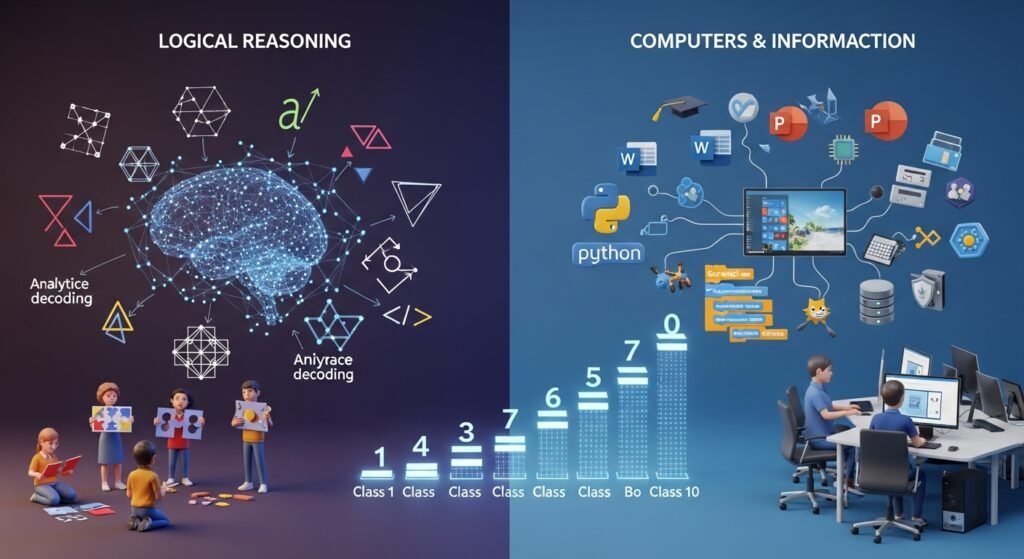
The NCO syllabus is divided into three distinct sections for each grade level, meticulously tailored to the developmental stage of the student while maintaining a rigorous upward trajectory in complexity. The examination primarily utilizes Windows 10/11 and Microsoft Office 2016 as the benchmark software environments, ensuring that the questions remain relevant to contemporary professional and educational standards.
The Role of Logical Reasoning
Section 1 of the NCO focuses on Logical Reasoning, a component that often constitutes between 14% and 30% of the total score depending on the class level. For younger students in Grades 1 through 5, this section emphasizes spatial awareness, pattern recognition, analogies, and classification. As students advance to Grades 6 through 10, the reasoning component matures into complex verbal and non-verbal tasks, including syllogisms, mirror and water images, coding-decoding, and direction sense tests.
The inclusion of logical reasoning is critical because it assesses the student’s ability to think analytically and solve novel problems that are not explicitly covered in traditional IT textbooks. In competitive scoring, this section serves as a secondary tie-breaker after the Achievers Section, highlighting its importance in the overall rank determination.
Computers and Information Technology: The Core Curriculum
Section 2 represents the primary subject matter of the Olympiad. The syllabus is designed to be 60% reflective of the student’s current grade-level curriculum and 40% reflective of the previous grade, ensuring a solid foundation of prerequisite knowledge.
For primary school students (Classes 1-3), the focus is on the “Smart Machine” concept—understanding that a computer is an extension of human capability that requires specific input and output protocols. Students are tested on basic hardware identification, the history of MS Paint, and introductory MS Word functions such as opening and saving documents.
In the middle years (Classes 4-7), the curriculum expands significantly to include the evolution and generations of computers, detailed hardware-software differentiation, and the mechanics of storage devices. There is a progressive introduction to MS Office tools:
- MS Word: Formatting, mail merge, and advanced document editing.
- MS Excel: Formulas, sorting, filtering, and data visualization.
- MS PowerPoint: Slide masters, transitions, and animation logic.
Secondary level students (Classes 8-10) are challenged with systemic concepts such as networking topologies, internet protocols, and the fundamentals of cybersecurity and database management. This level also introduces programming logic through Scratch, Python, and Visual Basic, requiring students to understand binary systems and algorithmic structures.
Institutional Incentives: Awards and Scholarships for 2025-26
The Science Olympiad Foundation maintains one of the most comprehensive reward structures in the field of student competitions, providing international recognition and financial support to top performers. For the 2025-26 cycle, winners are recognized across three primary tiers: International, Zonal, and School.
International and Zonal Merit
At the international level, the top three students in each class across all participating zones are awarded significant cash prizes. The first-place winner receives ₹50,000, a gold medal, and a certificate of outstanding performance. The second and third places are awarded ₹25,000 and ₹10,000 respectively.
Zonal awards are distributed across the 26 recognized zones, ensuring that excellence is rewarded even if a student does not reach the absolute global top. The top three zonal rank holders receive ₹5,000, ₹2,500, and ₹1,000 respectively, along with their respective medals and certificates of excellence. Ranks from 4 to 25 are typically recognized with Medals of Distinction and Certificates of Distinction.
School Level Felicitations
To encourage localized excellence, the SOF provides Gold Medals of Excellence to school toppers. These are awarded based on participation thresholds:
- In classes with 5-9 participants, the top ranker receives a medal.
- In classes with 10-25 participants, the top three receive medals.
- In classes with more than 25 participants, the top 10% of rank holders are recognized.
Furthermore, all students who achieve a perfect score of 100% are automatically awarded the Gold Medal of Excellence. Each student also receives a detailed Student Performance Report (SPR), which provides a comparative analysis of their strengths and weaknesses against peers at the city, zonal, and international levels.
Specialized Financial Support Schemes
Beyond performance-based prizes, the SOF administers targeted scholarships to promote academic inclusivity. The Girl Child Scholarship Scheme (GCSS) provides ₹5,000 each to 300 girls from economically modest backgrounds. Additionally, the Academic Excellence Scholarship (AES) provides ₹5,000 to 260 students who demonstrate the highest cumulative performance across four different SOF Olympiads in a single academic year.
Pedagogical Strategies for Success: Topper Insights and Expert Advice
Excelling in the National Cyber Olympiad requires more than rote memorization; it demands a strategic approach to problem-solving and time management. Insights gathered from expert discussions and historical performance trends highlight several critical preparation pillars.
Conceptual Mastery vs. Rote Learning
A recurring theme in topper interviews is the focus on “conceptual understanding”. The NCO often presents questions that require applying a simple principle to a complex or unfamiliar scenario. For instance, understanding the logic of how a browser interacts with a server is more valuable than memorizing a list of HTML tags. Experts suggest using NCERT textbooks as a foundation but moving quickly to Olympiad-specific guides, such as the MTG Workbooks, which are tailored to the SOF pattern.
The Logic-First Approach
Because Logical Reasoning (Section 1) and the Achievers Section (Section 3) act as the primary filters for top ranks, successful candidates often prioritize these in their daily study routines. Regular practice of puzzles, coding-decoding exercises, and direction-sense tests builds the mental agility required to solve these problems quickly during the actual 60-minute examination.
Temporal Management and Simulation
A common mistake made by smart students is spending excessive time on a single difficult question, thereby losing the opportunity to answer multiple easier questions. Preparation should involve solving at least five years of previous question papers and multiple mock tests under strict 60-minute timers.
Students are often advised to use a “three-round method” during the exam:
- Round 1: Answer all easy, high-confidence questions instantly.
- Round 2: Address moderately difficult questions that require some calculation or logical deduction.
- Round 3: Tackle the toughest questions if time permits.
Since there is no negative marking in the SOF NCO, students are encouraged to make “educated guesses” rather than leaving any questions blank.
Online Exam Glitches
While the SOF NCO is primarily offline, competitor exams such as the CREST Cyber Olympiad (CCO) or Unicus are online and proctored via webcam. In online formats, technical glitches such as internet loss or browser crashes are common. Platforms like Unicus offer troubleshooting guides that include refreshing the page or switching to a backup network (mobile data). In cases of genuine, unresolved technical failure, these online providers often offer to reschedule the exam at no additional cost.
The Competitive Landscape: Comparing NCO with Global Informatics Olympiads
While the SOF NCO is the most widely recognized cyber-focused Olympiad in India, it exists within a broader ecosystem of competitive informatics exams. Understanding these differences allows educators to choose the most appropriate platform for their students.
The Silverzone International Informatics Olympiad (iiO) offers a three-level progression, making it more challenging for top-tier students. Meanwhile, the Singapore National Cybersecurity Olympiad (NCO) is far more specialized, focusing on professional-level skills such as Capture the Flag (CTF) challenges, Linux environments, and digital forensics. The SOF NCO maintains its popularity by offering a balanced, curriculum-aligned approach that makes advanced computing accessible to millions rather than just elite coders.
Future Outlook: Cyber Security and Ethical Tech Education
As the National Cyber Olympiad evolves toward the 2025-26 cycle, there is a distinct trend toward incorporating “cyber awareness” and “ethical hacking” concepts into the curriculum, even at the school level. The Cyber Olympiad Foundation and the SOF both emphasize that digital skills are no longer just about software proficiency but about understanding the safety, security, and ethical implications of technology.
The integration of artificial intelligence (AI), robotics, and data science into the ICSO syllabus for middle and secondary grades reflects the reality of the 21st-century job market. By testing students on these emerging trends, the Olympiad ensures that the next generation is not just a consumer of technology but a critical, security-conscious architect of the future digital world.
Conclusion: Synthesizing the NCO Experience
The National Cyber Olympiad 2025-26 is more than a standardized test; it is an institutionalized mechanism for fostering computational excellence in the youth. Through its partnership with schools, its rigorous class-wise curriculum, and its substantial reward system, the Science Olympiad Foundation provides a platform where theoretical classroom knowledge is transformed into analytical prowess.
Success in this arena is a function of early preparation, conceptual clarity, and meticulous attention to examination logistics. For students, the NCO represents a milestone in their academic journey, offering international benchmarking and building the confidence required to pursue careers in the highest tiers of science and technology. As digital environments become increasingly complex, the role of the NCO in shaping capable, ethics-conscious, and technically proficient leaders will only continue to expand. Schools, parents, and students who engage deeply with the Olympiad process are not just competing for medals; they are investing in the cognitive infrastructure required to thrive in the digital age
FAQS
The National Cyber Olympiad (NCO), now aligned with the International Computer Science Olympiad (ICSO), is a competitive examination that evaluates students’ computer knowledge, logical reasoning, cybersecurity awareness, and problem-solving skills.
The NCO is conducted by the Science Olympiad Foundation (SOF), a reputed non-profit educational organization established in 1998.
Students from Class 1 to Class 10 are eligible to participate. In some regions, participation may extend up to Class 12.
No. Individual registrations are not allowed. Students must register through their respective schools.