

In the complex world of professional services, an engineering firm’s “business classification” is far more than a bureaucratic checkbox. For firm owners and stakeholders, accurate classification is the strategic DNA that dictates everything from tax liability and insurance premiums to eligibility for lucrative government contracts.
Whether you are a solo structural consultant or a multinational EPC (Engineering, Procurement, and Construction) contractor, how you define your business determines your operational reality. A misstep here can lead to costly audits, denied insurance claims, or disqualification from federal bidding wars. This guide explores the multi-dimensional criteria used to classify engineering firms in 2026, integrating standard regulatory frameworks with emerging trends and insights from leading industry voices.
2. Core Classification Frameworks
Engineering firms are categorized through four primary lenses: regulatory codes, legal structure, project delivery models, and size. Understanding each is critical for strategic positioning.
A. Regulatory Industry Codes (NAICS & SIC)
At the federal level, the North American Industry Classification System (NAICS) is the gold standard.
- NAICS 541330 (Engineering Services): This is the umbrella code for almost all pure engineering work. It covers civil, mechanical, electrical, and environmental engineering.
- Sub-Classifications: Importantly, this code has specific “exceptions” for Military and Aerospace Equipment and Military Weapons, which have different size standards.
- SIC Code 8711: While largely replaced by NAICS, the Standard Industrial Classification (SIC) code 8711 is still used by some private sector databases and older insurance policies.
Why it matters: If you want to bid on a federal highway project, your business must be registered under NAICS 541330. Listing yourself under “Management Consulting” (NAICS 541611) by mistake could disqualify your bid instantly.
B. Legal Structure: The PLLC vs. LLC Distinction
For most businesses, a Limited Liability Company (LLC) is the default choice. However, the engineering profession faces a unique regulatory hurdle.
- The PLLC Requirement: Many states, including New York and Virginia, classify engineering as a “learned profession” (similar to medicine or law). Consequently, licensed Professional Engineers (PEs) are often prohibited from forming a standard LLC. Instead, they must form a Professional Limited Liability Company (PLLC).
- The Ownership Rule: A key classification criterion for a PLLC is ownership. Typically, 100% (or a simple majority, depending on the state) of the ownership interest must be held by licensed professionals. This restricts non-engineers from owning the firm, a classification nuance that impacts investment and scaling strategies.
C. Project Delivery Models (Service Type)
Firms are often classified by how they deliver their services. This is the “market-facing” classification.
- Design-Bid-Build (DBB): The traditional “consulting” model. The firm provides design only. Liability is limited to professional negligence (errors and omissions).
- Design-Build (DB): The firm is responsible for both design and construction. This classification shifts the risk profile dramatically, as the firm is now liable for construction safety, schedule, and cost.
- EPC (Engineering, Procurement, Construction): Common in the energy and industrial sectors. An EPC firm is a “turnkey” provider.
- EPCM (Engineering, Procurement, Construction Management): Often confused with EPC. In EPCM, the firm acts as a consultant to manage the construction, but the client signs the actual construction contracts. This subtle classification difference has massive liability implications.
D. Size Standards (SBA)
The U.S. Small Business Administration (SBA) uses revenue limits to classify firms as “small” or “other than small.”
- The Threshold: As of recent updates, the size standard for NAICS 541330 (Engineering Services) is typically around 25.5millionto29 million in average annual receipts.
- The Impact: Firms falling below this threshold are classified as “Small Businesses,” granting them access to exclusive government “set-aside” contracts. Growing just $1 over this limit forces a firm to compete against industry giants like AECOM or Jacobs, a classification shift known as the “mid-market cliff.”
3. Issues and Challenges in Classification
Correct classification is rarely straightforward. Three primary pitfalls often trap firm owners.
The Insurance Liability Gap
Insurance carriers classify engineering firms based on risk exposure, not just revenue.
- Design vs. Construct: A firm classified as a “Design-Only” consultant pays significantly lower Professional Liability (PL) premiums than one classified as a “Design-Build” firm.
- The Issue: If a “Design-Only” firm starts taking on minor construction management tasks without updating their classification, they may accidentally void their insurance policy. A claim arising from a construction site accident could be denied because the firm was “misclassified” in the underwriter’s eyes.
Worker Classification: Employee vs. Contractor
The IRS scrutinizes engineering firms heavily regarding the classification of workers.
- The Scenario: Firms often hire project-based engineers as “Independent Contractors” (1099) to handle workload spikes.
- The Risk: Under the IRS “Common Law Rules” and recent Department of Labor updates, if you control how and when these engineers work, they are legally employees (W-2). Misclassifying them as contractors can lead to devastating audits, back taxes, and penalties.
Multi-State Licensing Complexity
A firm might be classified as a valid engineering corporation in its home state but fail the classification test in a neighboring state.
- Example: A firm in Texas (which allows standard LLCs for engineers) wins a project in New York (which requires a PLLC). The firm cannot legally execute the contract or get paid until it registers a compliant foreign entity, a process that can take months and derail project timelines.
4. Latest Trends and Insights (2025-2026)
The landscape of engineering business classification is shifting due to technology and market demands.
AI and the “Agentic” Firm
As highlighted in recent tech trends, the rise of Artificial Intelligence is challenging traditional size classifications.
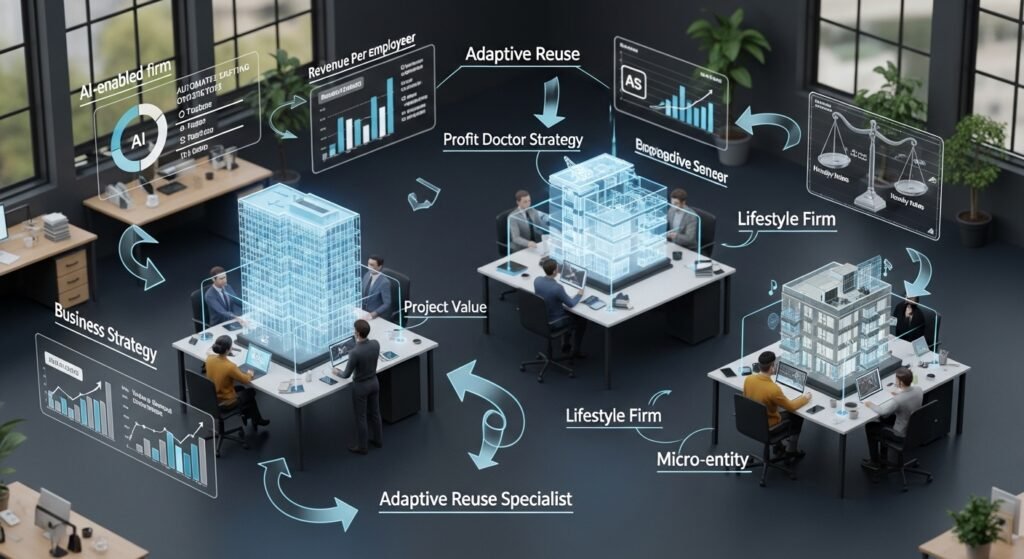
- Revenue per Employee: Traditionally, a firm with $5M in revenue might need 20-30 staff. With AI-driven generative design and automated drafting tools, a 5-person firm can now generate that same output.
- Impact: This skews SBA size standards (which often look at revenue). We may see future regulatory debates on classifying “tech-enabled” engineering firms differently from traditional labor-intensive ones.
Insights from the Industry (YouTube & Podcasts)
Leading industry channels like the Engineering Management Institute (EMI) and Civil Engineering Academy provide “boots on the ground” perspectives that often precede official regulation changes.
- The “Adaptive Reuse” Niche: On The Structural Engineering Channel (an EMI podcast), experts like Erin Rosenthal have discussed the booming trend of adaptive reuse (converting old offices to apartments). Firms are increasingly classifying themselves specifically as “Adaptive Reuse Specialists.” This micro-classification helps them win work in urban centers where new builds are stalled, differentiating them from generalist structural firms.
- The “Profit Doctor” Approach: In a recent feature on the Civil Engineering Academy, Ben Hansen (known as “The Profit Doctor”) emphasized that many firms misclassify their own value. He argues that firms often classify themselves as “commodity service providers” (charging by the hour) rather than “value-based partners.” Changing this internal classification—how you view and bill your own business—is cited as a key step in scaling from a struggling small business to a profitable enterprise.
- The “Burnout” Factor: Creator Mat Picardal has candidly shared how the “hustle” culture of traditional engineering business models leads to burnout. This has sparked a trend of younger engineers forming “lifestyle” firms—micro-entities deliberately classified and structured to remain small and specialized, rejecting the traditional “grow or die” classification ladder.
Sustainability as a Business Class
“Green Engineering” is no longer just a buzzword; it is becoming a formal classification for procurement.
- ESG Reporting: Large public clients now require vendors to meet Environmental, Social, and Governance (ESG) criteria. Firms are now seeking “B-Corp” certification or specific “Sustainable Business” classifications to qualify for these vendor lists, effectively creating a new tier of “ESG-Compliant” engineering firms.
5. Strategic Guide: How to Classify Your Firm Correctly
If you are starting or restructuring an engineering firm, follow this 4-step checklist:
6. Conclusion
Classifying an engineering business is an exercise in precision. It requires balancing the rigid definitions of the IRS and SBA with the fluid, project-based reality of the construction world. Whether navigating the distinct legal requirements of a PLLC, managing the liability risks of an EPC model, or leveraging new “niche” classifications like adaptive reuse, the successful firm owner treats classification not as paperwork, but as strategy. In an era of AI automation and sustainability mandates, those who accurately define who they are and what they do will be best positioned to build the future.
FAQS
SBA uses revenue thresholds (approximately $25–29 million for NAICS 541330). Falling below the limit grants access to small business set-aside government contracts.
AI enables smaller teams to achieve outputs previously requiring larger staff, challenging traditional revenue-per-employee benchmarks and potentially affecting SBA size standards.
Specializations like “Adaptive Reuse Specialists,” “Lifestyle Firms,” and ESG-compliant/sustainable engineering firms are becoming recognized categories that influence contracts and market positioning.
NAICS 541330 is the federal classification for most engineering services. Accurate registration is required to bid on government projects and maintain compliance.