
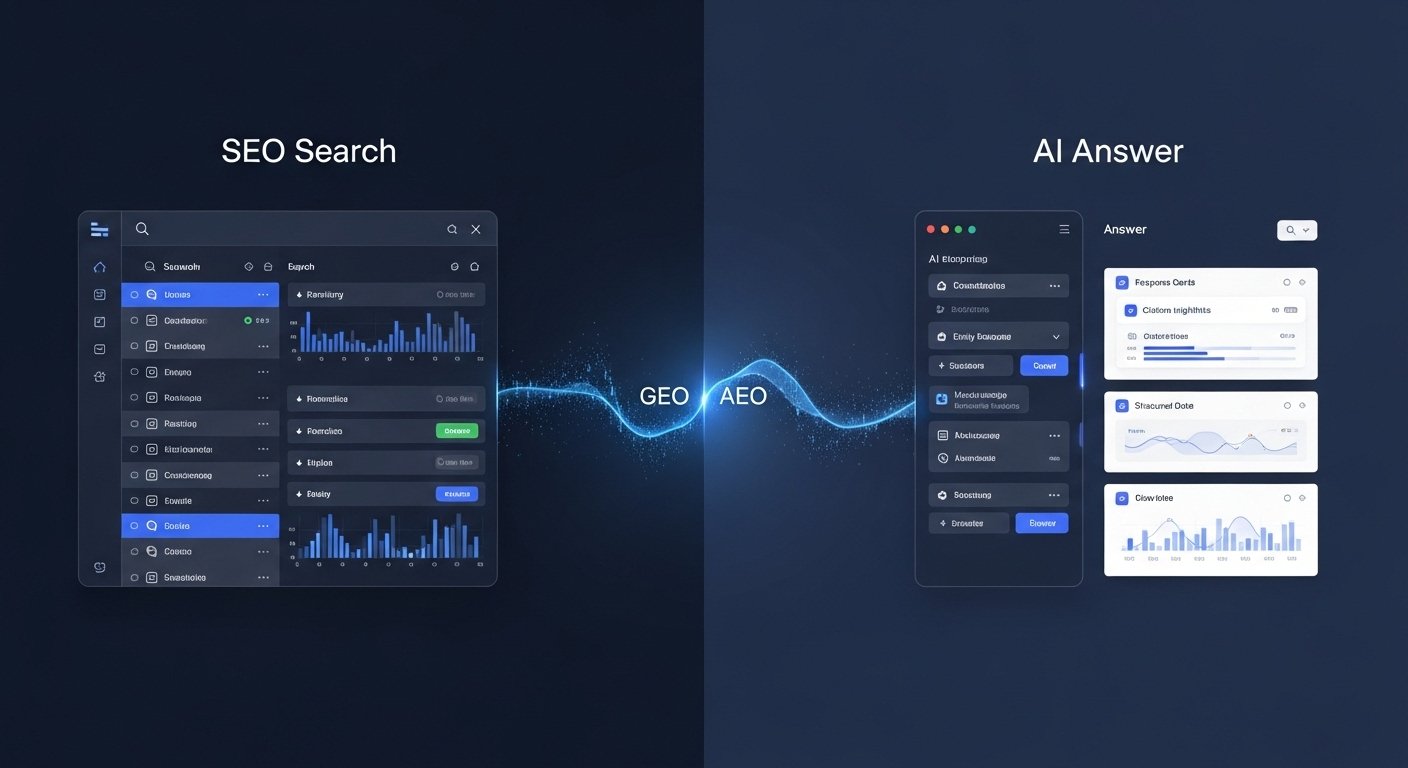
The global digital landscape is currently navigating a fundamental reconfiguration of information retrieval, marking the most significant transition since the commercialization of the internet. For over two decades, search engine optimization (SEO) served as the primary bridge between digital content and human intent, predicated on a system of keywords, backlinks, and indexable pages. However, the rise of Large Language Models (LLMs) and the subsequent integration of generative AI into search ecosystems—exemplified by Google’s AI Overviews, Microsoft’s Copilot, and conversational engines like ChatGPT and Perplexity—has rendered traditional ranking models insufficient. The emergence of Generative Engine Optimization (GEO) and Answer Engine Optimization (AEO) signifies a move away from “blue link” listings toward synthesized, direct responses that prioritize entity authority and semantic relevance over simple keyword matching.
For enterprise leaders and digital strategists, the shift toward AI-driven discovery presents both a significant risk of visibility erosion and a unique opportunity for traffic quality enhancement. Gartner’s prediction of a $25\%$ decline in traditional search volume by 2026 underscores the urgency of this transition, as millions of users shift their research habits toward AI assistants that provide answers without requiring a click-through to a website. In this context, AI search monitoring tools have evolved from experimental utilities into essential strategic infrastructure. These platforms provide the diagnostic data necessary to understand how a brand is perceived, cited, and recommended within the latent spaces of LLMs, where traditional analytics platforms like Google Search Console offer little visibility.
The Obsolescence of Traditional Ranking Models and the Rise of Zero-Click Search
The primary driver for the adoption of AI search monitoring tools is the systemic failure of traditional SEO metrics to explain outcomes in a generative environment. For years, digital success was measured by Page 1 rankings and click-through rates (CTR). However, the “zero-click” phenomenon—where a user’s query is satisfied directly on the results page—has been exacerbated by AI-generated summaries. When an AI provides a comprehensive answer at the top of the SERP, users often find the information they need immediately, leading to a decline in traditional web traffic.
This shift is not merely a change in layout but a change in the “runtime” of the internet. Traditional SEO targets algorithms that rank pages; GEO targets models that tokenize content and synthesize it into new answers. This creates a “citation-first” environment where a brand’s presence is determined not by where it ranks on a list, but by whether it is a trusted source used to build the AI’s response. Research indicates that brand mentions, even without direct links, have become a powerful signal for AI systems, functioning as the modern equivalent of the backlink.
| Metric | Traditional SEO Orientation | AI Search / GEO Orientation |
| Primary Success Indicator | SERP Position (1-10) | Citation Frequency / Share of Voice |
| Traffic Mechanism | Clicks from Blue Links | Conversational Referrals / Citations |
| Content Evaluation | Keyword Density / Backlinks | Entity Clarity / Source Corroboration |
| User Interaction | Transactional / Navigation | Conversational / Research-Oriented |
| Technical Foundation | Site Audits / XML Sitemaps | Machine-Readable Endpoints / llms.txt |
Without monitoring tools, businesses remain unaware of their “Share of Voice” (SOV) across different LLMs. For example, a brand might rank well on Google for “best cloud security,” yet be completely omitted from a ChatGPT response to the same query because its content is not structured for citation-readiness or lacks multi-source corroboration. The “fragmented digital attic”—outdated data, expired pricing, and inconsistent brand signals scattered across the web—now poses a direct threat to visibility, as AI models prioritize sources that appear consistently accurate and credible across the entire digital ecosystem.
The Convergence of Intent Mapping and Predictive Performance
AI search optimization tools increase organic traffic by fundamentally changing how intent is mapped and how content is prioritized. In the traditional framework, intent was often categorized into broad buckets: informational, navigational, commercial, and transactional. AI tools in 2025 and 2026 utilize Natural Language Processing (NLP) to perform highly granular “AIO Query Intent Mapping,” identifying the specific patterns in query phrasing that trigger AI-generated summaries.
The Mechanism of Automated Intent Mapping
Modern tools analyze massive datasets from SERPs, social media, and forums to uncover how users phrase complex, conversational questions. Instead of targeting the keyword “CRM software,” these tools identify that users are asking, “What is the best CRM for a mid-sized SaaS company with a remote sales team?”. By mapping these long-tail, high-intent prompts to strategic content types, brands can create “surgical snippets” that are more likely to be extracted and cited by AI engines.
This automated mapping allows for “Intent-to-Answer Mapping,” which ensures that a brand’s content resolves the exact purpose behind a user’s prompt. When an AI system like Google’s Gemini or OpenAI’s ChatGPT evaluates multiple sources to build an answer, it prioritizes content that provides a direct, verifiable solution to the user’s specific problem.
| Intent Type | Trigger Phrase Example | AI Optimization Goal |
| Complex Informational | “How to optimize X while maintaining Y” | Comprehensive Synthesis Inclusion |
| Comparison-Based | “Difference between Brand A and Brand B” | Inclusion in Comparison Tables |
| Research-Oriented | “Latest trends in renewable energy 2026” | Citation as a Primary Research Source |
| Troubleshooting | “Why is my software doing X after the update” | Snippet Inclusion in Step-by-Step Guides |
Predictive Analytics and Trend Forecasting
The strategic value of AI monitoring tools extends into the realm of predictive performance. Machine learning models can now forecast the likely ranking potential and ROI of a content piece before it is even published. These systems analyze historical data—including CTR, bounce rates, and domain authority changes—to model how a new page will compete against existing content clusters.
Predictive SEO allows teams to act on the “crest of demand curves” rather than retroactively adjusting content to past trends. For example, if a monitoring tool detects a rising semantic cluster around “sustainable supply chain logistics” in industry forums, a brand can deploy optimized content to capture that trend before it becomes a saturated keyword space. This “first-mover advantage” is critical because AI models tend to cite established, authoritative sources that have provided consistent information over time.
The accuracy of these predictive models is statistically significant. Recent studies comparing predictive SEO tools have shown strong correlations between predicted and actual rankings, with Kendall Tau and Spearman correlations providing a rigorous framework for evaluating content viability.
$$Kendall \ Tau \ Correlation = 0.2312$$
$$Spearman \ Correlation = 0.3216$$
These values indicate that modern AI tools can provide a reliable “SEO report card,” allowing marketers to focus resources on content with the highest probability of gaining AI visibility and driving organic growth.
The Impact of AI Search on Organic Traffic Quality and Engagement
A nuanced understanding of AI search reveals that while raw traffic volume may face downward pressure, the quality of traffic often increases. This is a critical insight provided by AI monitoring tools: traffic from AI-powered search engines often delivers higher engagement value than traditional search traffic.
High-Intent Pre-Education
Users who interact with AI assistants are often in a “research and exploration” phase. By the time they click a citation link to visit a brand’s website, they have been “pre-educated” by the AI’s summary. This results in visitors who are more qualified and ready to engage with specific products or services. Case studies have observed that while overall organic traffic might slip by $18\%$, the conversion rates from those remaining visitors can rise by as much as $22\%$.
Data from Hedges & Company and other industry analysts in 2025 demonstrate this shift in engagement metrics. AI referral traffic often displays significantly different behavior compared to traditional organic search, characterized by higher engagement rates and lower average engagement times, as users have already found their primary answer and are visiting for deeper verification or specific action.
| Engagement Metric | Traditional Organic Traffic | AI Referral Traffic |
| Engagement Rate | Baseline | $+4\% \text{ to } +35\%$ Higher |
| Average Session Duration | Baseline | $21\% \text{ to } +30\%$ Lower |
| Bounce Rate | Baseline | $23\% \text{ to } +40\%$ Lower |
| Page Views per Session | Baseline | $+12\%$ Higher |
The decrease in average engagement time per session, while seemingly negative in a traditional context, actually suggests that visitors are finding the specific information they need faster through optimized content. This efficiency builds brand trust and authority, as the brand is associated with providing direct, helpful solutions.
Case Study: Real Estate Organic Growth
One prominent example of AI-driven organic growth is the case of Randy Selzer, a real estate professional who achieved an $80\%$ increase in organic traffic and a $61\%$ increase in website visits through the integration of AI-powered keyword optimization and entity-based search strategies. By using tools like WordLift to automate keyword research and align content with conversational intent, Selzer was able to move beyond simple keyword matching to capture the context and meaning behind user queries. This approach also led to a $40\%$ reduction in bounce rates, demonstrating that the traffic gained was highly relevant and engaged.
Quantifying Visibility Through Latest Industry Reports and Intelligence
The transition to AI-driven search is not a future possibility but an active transformation. Monitoring the “AI Visibility Index” has become as important as monitoring traditional rankings. Industry reports from 2025 reveal that Google’s AI Overviews now appear in over $13\%$ of queries, a $100\%$ increase in just two months. This expansion is predominantly driven by informational intent, where users seek “how-to” guides, definitions, and complex synthesis.
YouTube Insights: The AEO, GEO, and AIO Framework
Leading digital marketing analysts on platforms like YouTube have refined the terminology used to describe these optimization layers. A critical distinction is made between Answer Engine Optimization (AEO), Generative Engine Optimization (GEO), and Artificial Intelligence Optimization (AIO) :
- AEO (Answer Engine Optimization): Focuses on being the direct answer cited in Google AI Overviews or Bing Snapshots. Success depends on “answer-first” content structures and addressing “People Also Ask” patterns.
- GEO (Generative Engine Optimization): Targets recommendations within conversational tools like ChatGPT and Perplexity. Success is driven by “fitness and synthesis signals,” where the AI summarizes information from multiple authoritative sources.
- AIO (Artificial Intelligence Optimization): Involves the broader effort to make a brand “known” to AI systems through structured data, authority ecosystems, and “consensus signals” across the entire web.
These insights suggest that ranking #1 on Google no longer guarantees revenue. If an AI does not “trust” or “feel confident” recommending a brand, that brand may effectively cease to exist for millions of users. Monitoring tools allow brands to check their “Share of Voice” by prompt and model, identifying exactly which competitors are winning citations and recommendations.
The Growth of AI Referrals
Data from Adobe and Semrush indicate that traffic from AI-driven referrals increased more than tenfold between late 2024 and early 2025. Although AI search currently accounts for a small fraction (often less than $1\%$) of total web traffic for most sites, its growth rate is $165\times$ faster than that of traditional organic search. This explosive growth signals a permanent shift in discovery, making early adoption of monitoring tools a key competitive advantage.
Mapping the Non-Linear AI-Shaped User Journey
The traditional marketing funnel—a linear progression from awareness to consideration to decision—is being replaced by a complex, non-linear “influence map”. AI assistants have compressed these stages, allowing users to move fluidly between research and decision-making within a single conversation.
The Zigzagging Buyer
Today’s buyers “zigzag” through the digital ecosystem, often interacting with $7\text{ to } 13$ different brand touchpoints before ever visiting a website. They may discover a brand on social media, validate it through a Reddit thread, research competitors via ChatGPT, and finally convert through a direct search. AI search monitoring tools are uniquely capable of tracking these fragmented paths, uncovering “hidden touchpoints” like third-party review sites, niche forums, and podcast mentions that traditional analytics often miss.
Real-Time Intent Scoring and Personalization
By using AI to analyze thousands of data points from CRMs and social media, businesses can now assign “real-time intent scores” to every user interaction. This allows for “dynamic journey orchestration,” where the brand can provide personalized content paths based on the user’s observed behavior.
The non-linear journey is characterized by “loops,” where users revisit earlier stages as new doubts arise or new information is discovered. AI-powered monitoring helps identify these “moments of friction” and drop-off points, enabling teams to refine their optimization efforts to better support the user at every step, regardless of the order in which they encounter the brand.
Solutions, Troubleshooting, and Strategic Optimization Tips
For organizations facing visibility drops or struggling to enter the AI response layer, a systematic approach to optimization and troubleshooting is required. AI search monitoring tools provide the “symptoms,” but human experts must perform the “diagnosis” and implement solutions.
Troubleshooting AI Visibility Drops
Visibility drops in 2026 are often tied to technical or authority-based issues rather than simple ranking fluctuations. Common “slip-ups” that drag down AI search performance include :
- The “Digital Attic”: Outdated pricing, expired statistics, or former executives still being cited as current information can confuse AI systems. AI models prioritize consistency; if your own site or external profiles offer conflicting facts, the AI may decide it is “safer” not to mention your brand at all to avoid errors.
- Technical Obscurity: Content hidden behind paywalls, gated forms, or heavy JavaScript is often inaccessible to AI crawlers. Many AI bots, including GPTBot and Bingbot, respect robots.txt directives; if these bots are accidentally blocked, the brand will remain invisible to their respective platforms.
- Schema Inconsistency: Structured data must be refreshed every time content is updated. If the JSON-LD markup does not match the visible text, the AI’s “confidence score” in the content will drop, leading to fewer citations.
The “Answer-First” Content Strategy
To increase the likelihood of being cited, content must be structured for machine readability. The “Answer-First” format is currently the gold standard for GEO and AEO.
- Lead with a Direct Answer: The first $40\text{ to } 60$ words of a page or section should provide a crisp, verifiable solution to the target question.
- Use Question-Based Headings: Structure content using descriptive H2s and H3s that reflect how people actually speak to AI assistants (e.g., “What is the typical price for X?”).
- Include Rich Formatting: Bulleted lists, comparison tables, and FAQ sections are more “extractable” for AI systems. Listicles and comparison charts reportedly dominate nearly one-third of AI citations.
- Strengthen Entity Signals: Ensure brand names, product details, and leadership information are consistent across all “AI-sourced” platforms, including Wikipedia, LinkedIn, and major industry journals.
Authority and Trustworthiness (E-E-A-T)
AI systems do not just look for keywords; they evaluate “entity integrity”. Building authority means being “talked about” in the right spaces. Monitoring tools track citations from tier-1 publications, analyst reports, and high-authority news sites, which act as the ultimate trust signals for LLMs.
Creating “data assets” that AI will cite—such as industry reports, original surveys, and ROI studies—positions a brand as a primary source of information. AI engines reward content that serves as an original reference point rather than content that merely comments on existing data.
| Trust Signal | AI Detection Mechanism | Strategic Solution |
| Expert Credentials | Author bios and entity graphs | Highlight author qualifications and industry certifications |
| Factual Consistency | Cross-source corroboration | Maintain consistent NAP and product data across directories |
| Original Insight | Retrieval of primary data | Publish original research, surveys, and case studies |
| Brand Recognition | Co-occurrence network analysis | Increase leadership visibility through guest podcasts and LinkedIn |
The Future Outlook: Agentic AI and Redefined ROI
As search continues to evolve into 2026, the industry is moving beyond generative answers toward “Agentic AI.” These are autonomous AI agents that can analyze behavior patterns, predict customer needs, and execute complex workflows without human intervention. In this future, the value of AI search monitoring tools will grow even further, as businesses will need to manage how these agents interact with their brand ecosystem.
The definition of SEO success is also being redefined. Traditional metrics like sessions and pageviews are being supplemented by “Brand Recall” and “Answer Share”. Even if a user does not click through to a website, the fact that a brand was recommended as the “best solution” by an AI assistant builds massive trust and authority, which often results in direct conversions later in the journey.
The search landscape has shifted permanently. Businesses that continue to rely solely on traditional keyword-heavy strategies will see their organic traffic “flatline or slip”. By adopting an “AI-first mindset” and leveraging monitoring tools to track visibility, sentiment, and citation frequency, brands can ensure they remain at the center of the conversational discovery process.
Ultimately, AI search monitoring tools are about more than just numbers; they are about understanding the new “voice of the searcher” and ensuring that when the future asks a question, your brand is the one that provides the answer. Success in this new era requires a balance of machine-like computational efficiency and human-centered strategic oversight, combining the power of AI with the authenticity and creativity that only humans can provide.
FAQ’S
AI search uses large language models to generate direct answers instead of showing blue link results. Unlike traditional SEO, it prioritizes entity authority, semantic relevance, and trusted citations over keyword rankings.
AI search monitoring tools track how brands appear, are cited, or are recommended across AI platforms. They measure AI Share of Voice, brand mentions, sentiment, and visibility that traditional SEO tools cannot capture.
Effective optimization includes: clear answer-first sections, semantic relevance, entity clarity, rich FAQ structures, schema markup, and consistency in terminology. Content must directly address conversational queries to be used by generative engines.
Traditional SEO uses rank and CTR. AI visibility metrics include Answer Share-of-Voice (A-SOV), citedness, and recommendation strength across AI platforms, helping measure how often your brand appears in AI responses