

The Economic Landscape of Pharmacy Technician Compensation (2024–2026)
The valuation of the pharmacy technician role within the United States healthcare system has undergone a fundamental reassessment between 2024 and 2026. Historically viewed as a supportive, clerical position, the modern pharmacy technician has emerged as a high-stakes technical professional responsible for the integrity of the pharmaceutical supply chain, the accuracy of complex sterile preparations, and the management of sophisticated automated systems. This professional evolution is mirrored in the shifting compensation models that now define the industry. As of mid-2024, the median annual wage for pharmacy technicians reached approximately $43,460, representing an hourly rate of $20.90. However, these baseline figures conceal a highly stratified labor market where geography, setting, and technological proficiency create vast disparities in earning potential.
Statistical benchmarks provided by the Bureau of Labor Statistics (BLS) illustrate a wide distribution of earnings across different percentiles. At the entry-level, or 10th percentile, technicians typically earn around $35,100 annually, a figure often associated with retail environments in regions with a lower cost of living. Conversely, those in the 90th percentile—frequently senior technicians in specialized hospital or informatics roles—can command salaries exceeding $59,450. This spread highlights a profession that, while accessible to those with a high school diploma, offers significant rewards for those who pursue advanced certification and institutional experience.
The employment outlook remains robust, with a projected growth rate of 6 to 7 percent through 2034, which is notably faster than the average for all occupations. This growth is driven by an aging population, increased access to healthcare, and a persistent shortage of qualified professionals, which has forced many healthcare systems to increase starting wages and sign-on bonuses to remain competitive. The following table outlines the national wage distribution as it stood in the 2024–2025 period, providing a baseline for the advanced roles discussed later in this analysis.
| Earnings Percentile | Annual Salary | Hourly Rate |
| 10th Percentile | $35,100 | $16.88 |
| 25th Percentile | $36,920 | $17.75 |
| 50th Percentile (Median) | $43,460 | $20.90 |
| 75th Percentile | $48,580 | $23.36 |
| 90th Percentile | $59,450 | $28.58 |
While these figures represent a nationwide average, the actual take-home pay for a technician is influenced by a complex interplay of experience, certification, and the specific regulatory environment of their state.
Geographic Variability and the Metropolitan Compensation Premium
Geography remains the single most influential variable in determining a pharmacy technician’s salary. The disparity between the highest-paying states and the lowest-paying regions can exceed 80 percent, a gap that often correlates with state-level certification requirements, the density of major healthcare hubs, and the regional cost of living. Data from 2024 and 2025 shows that states in the Pacific Northwest and the West Coast consistently lead the nation in mean wages.
California, Washington, and the District of Columbia represent the upper echelon of the pay scale. In California, the mean annual wage is approximately $55,710, with hourly rates averaging around $27. These high wages are a direct response to the intense demand for technicians in large medical centers and the necessity of offsetting the state’s high housing and transportation costs. Similarly, Washington and Oregon offer competitive salaries, with mean annual figures of $55,390 and $50,440, respectively.
| State | Employment Total | Hourly Mean Wage | Annual Mean Wage |
| California | 41,420 | $27.00 | $55,710 |
| Washington | 8,890 | $27.00 | $55,390 |
| District of Columbia | 740 | $26.00 | $54,030 |
| Oregon | 4,610 | $24.00 | $50,440 |
| Alaska | 860 | $23.95 | $49,810 |
The compensation landscape in metropolitan areas provides even greater resolution on these trends. Cities such as San Francisco and San Jose, California, report some of the highest technician salaries in the world, with experienced professionals sometimes earning upwards of $79,930. However, the cost of living in these areas often necessitates such high wages. Technicians on professional forums frequently discuss the “California Struggle,” where a $25 or $30 hourly wage feels insufficient due to rent prices in the Bay Area or Los Angeles.
In contrast, technicians in states like Alabama, Arkansas, and West Virginia face a different economic reality. In Alabama, the average annual pay is around $29,700, reflecting a lower cost of living but also a less competitive job market. West Virginia reports a mean salary of $31,024, which, while lower in nominal terms, may offer a comparable quality of life when adjusted for local expenses.
The Texas market serves as a unique case study in regional variation within a single state. Across the “Lone Star State,” the average pay for an oncology-focused technician is $37,335, but in specific cities like Clear Lake Shores, the average can jump to $45,835. This highlights the importance of localized job searches, as being just 50 miles away from a major medical hub can impact an hourly wage by several dollars.
Workplace Stratification: Institutional vs. Retail Realities
The setting of a technician’s work environment is a critical determinant of both their daily experience and their financial trajectory. The industry is broadly divided between retail (community) pharmacies and institutional (hospital or clinic) settings, with a growing third sector in mail-order and specialty fulfillment.
The Institutional Advantage: Hospitals and Ambulatory Care
Institutional pharmacy technicians consistently earn more than those in retail, with estimates suggesting a 20 percent premium for hospital-based roles. This pay gap is justified by the increased complexity of the duties involved. Hospital technicians are responsible for compounding sterile intravenous medications, managing automated dispensing cabinets (ADCs) like Pyxis or Omnicell, and participating in unit-dose distribution systems that require high precision.
| Work Environment | Median Annual Salary |
| Ambulatory Healthcare Services | $49,920 |
| Hospitals (State, Local, Private) | $49,310 |
| General Merchandise Retailers | $46,180 |
| Grocery/Specialty Food Stores | $38,810 |
| Pharmacies and Drug Retailers | $37,900 |
Technicians in ambulatory care centers—those that provide outpatient services and surgical care—earn the highest median wage at $49,920. This sector often involves specialty infusion or oncology services, where the risks of handling hazardous drugs command a higher base pay.
The Retail Struggle: Challenges in Community Pharmacy
Despite employing over 52 percent of the technician workforce, the retail sector offers the lowest median salaries, averaging around $37,900. Technicians in these environments—ranging from national chains like CVS and Walgreens to independent pharmacies—often report higher levels of burnout and lower job satisfaction. The work is characterized by high-volume prescription processing, intensive patient interaction, and administrative tasks such as insurance adjudication and prior authorization management.
A recurring theme in professional discussions is the “wage freeze” and stagnant raises common in corporate retail. Many technicians report that getting certified through the PTCB might only net a one-dollar-per-hour increase, or in some cases, no raise at all if the company is undergoing cost-cutting measures. This has led to a trend of “job hopping,” where technicians gain a year of experience in retail and then immediately seek employment in a hospital or specialty setting to secure a significant wage increase.
Career Advancement and the Specialized Technician Tiers
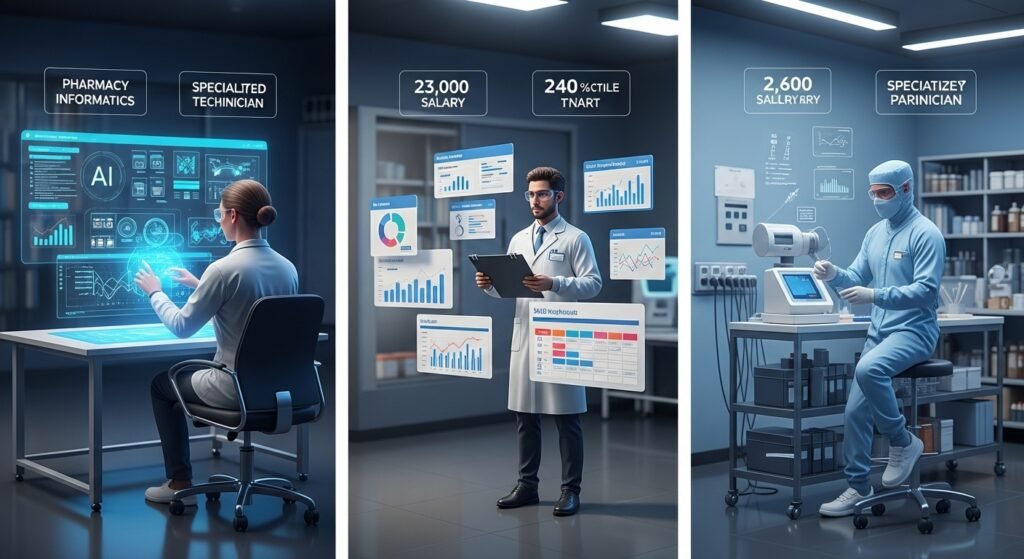
To break through the $50,000 to $60,000 salary ceiling that exists for general technicians, professionals must specialize. By 2026, several niche roles have emerged that offer salaries comparable to some nursing or administrative positions.
Pharmacy Informatics and Technology Specialists
As healthcare systems move toward “AI-first” environments, the role of the Pharmacy Informatics Technician has become indispensable. These professionals manage the software and hardware that drive the medication use process, from the Electronic Health Record (EHR) to automated robotics.
While the technician-level informatics role averages $40,074, those who transition into Informatics Specialist or Manager roles can see their compensation skyrocket. Advanced roles in this sector, such as a Pharmacy Informatics Manager, can earn upwards of $156,236—nearly 290 percent more than the technician average. This role requires a blend of pharmacy knowledge and IT skills, often involving the troubleshooting of automated dispensing systems and the optimization of clinical decision support tools.
The 340B Program Analyst: Regulatory and Financial Expertise
The 340B Drug Pricing Program is a federal initiative that provides significant discounts on outpatient drugs to “covered entities” serving vulnerable populations. Managing the compliance and financial auditing of this program has created a high-demand niche for technicians with strong analytical skills.
| 340B Related Job Title | Annual Salary (National Avg) |
| Pharmacy Business Analyst | $98,662 |
| Pharmacy Audit Analyst | $89,650 |
| 340B Pharmacy Analyst | $57,426 |
| 340B Senior Pharmacy Analyst | $62,400 – $90,750 |
| 340B Pharmacy Supervisor | $135,000 – $217,000 |
Senior 340B Analysts often work in a hybrid or remote capacity, reviewing claims data to identify missed savings or potential compliance risks. This career path offers some of the highest non-pharmacist salaries in the industry, with managers in this space earning well into the six-figure range.
Oncology and Nuclear Pharmacy
Specialization in hazardous or radioactive medication preparation is another path to high compensation. Oncology technicians, who prepare chemotherapy and other biologic agents, earn an average of $55,250. In Texas, the average for this role is slightly lower at $37,335, but specialized “Infusion Technicians” in the state can earn over $51,498.
Nuclear pharmacy technicians, who handle radiopharmaceuticals used in diagnostic imaging and cancer treatment, are among the most specialized in the field. While the BLS groups nuclear medicine technologists separately (with a median pay of $97,020), pharmacy technicians who assist in these specialized “clean room” environments command a significant premium over general staff.
Technological Convergence: AI, Robotics, and the Amazon Influence
The pharmacy industry of 2026 is defined by a rapid shift toward automation and artificial intelligence. These technologies are not merely replacing tasks; they are fundamentally redefining the “top of license” practice for technicians, allowing them to focus on clinical support rather than manual counting.
Amazon Pharmacy and the Central Fill Model
Amazon Pharmacy is currently the most visible force in the “central fill” and “micro-fulfillment” trend. By leveraging AI to predict demand and route prescriptions to fully automated fulfillment centers, Amazon has reached a level of efficiency that traditional retail pharmacies struggle to match.
These centers utilize sophisticated robotics such as the BD Rowa system, which can store up to 35,000 medication packages and dispense 2,400 items per hour with 99.99% accuracy. Major hospital systems that have implemented similar systems report a 50 percent reduction in dispensing labor, allowing technicians to transition from the filling station to the patient’s bedside for medication reconciliation or discharge counseling.
However, this shift is not without controversy. The National Community Pharmacists Association (NCPA) has raised concerns about the “vending machine” approach to pharmacy, arguing that it reduces a complex clinical process to a simple commodity transaction. For technicians, this means that while their roles are becoming more technical and potentially higher-paying, the human element of patient care in community settings is under pressure.
The Human-AI Hybrid Workforce of 2026
By 2026, the industry has reached a “hybrid” state. In this model, robotic systems manage approximately 70 percent of the routine prescription volume. AI systems now handle the processing of insurance claims and the flagging of potential drug-drug interactions, while technicians oversee the maintenance and calibration of these systems.
This transformation is a primary driver for the increased wages seen in the 75th percentile of the profession. A technician who understands how to troubleshoot an automated dispensing cabinet or navigate an AI-driven inventory management platform is significantly more valuable than one who only possesses manual counting skills. The “shortage of qualified technicians” mentioned in current reports is specifically a shortage of tech-enabled technicians who can thrive in these automated environments.
The Pentagon-Tesla Connection: Logistics and Biodefense in Healthcare
The intersection of “Big Tech” and national infrastructure is not limited to the healthcare sector. A significant parallel exists in the defense industry, where the Pentagon’s recent shift toward Silicon Valley innovation mirrors the pharmacy sector’s adoption of Amazon-style automation. This “Musk-style” defense reform, championed by leaders looking to accelerate military innovation, has brought companies like SpaceX, Palantir, and Tesla into the center of national security.
The Air Force Cybertruck Acquisition: A Case Study in Innovation
In a move that captured global attention in 2025 and 2026, the U.S. Air Force acquired a fleet of Tesla Cybertrucks for testing at the White Sands Missile Range. While these vehicles were destined for destruction during live-fire missile testing, the reasoning for their selection was purely technical. The Air Force Test Center (AFTC) cited the Cybertruck’s 48V electrical architecture and unpainted stainless steel exoskeleton as unique features that current military-grade vehicles are only beginning to explore.
The military’s interest in “repurposed consumer technology” reflects a broader trend toward speed and efficiency. Just as the Pentagon can no longer wait a decade for legacy defense firms to deliver a perfect system, pharmacy leaders can no longer wait for traditional staffing models to solve the medication access crisis. The “Cybertruck narrative” is emblematic of the “dual-use” nature of modern technology—where the same AI and hardware that power a consumer vehicle or a military target are being adapted to drive robotic pharmacy fulfillment and secure medical logistics.
Bioweapon Defense Mode and Hospital Cleanrooms
A specific technical cross-over between Tesla’s automotive innovation and pharmacy practice is found in “Bioweapon Defense Mode.” This system, standard on the Model S, X, Y, and Cybertruck, uses a medical-grade HEPA filter and cabin pressurization to create a sterile environment.
| Technical Feature | Tesla Bioweapon Defense Mode | Pharmacy Cleanroom (USP ) |
| Filtration Standard | HEPA (99.97% effective at 0.3μm) | HEPA (Standard for sterile compounding) |
| Pressurization | Positive pressure prevents ingress | Positive pressure prevents contamination |
| Carbon Filtration | Removes gases, odors, and VOCs | Removes odors and hazardous vapors |
| Rapid Recovery | Cleans air in <2 minutes | Rapid air exchange (ACH) requirements |
Tesla’s test results, which showed the cabin being cleaned of pollutants in under two minutes while parked in a hazardous smoke bubble, demonstrate a level of atmospheric control once exclusive to hospital pharmacies and surgical suites. For pharmacy technicians specializing in sterile compounding, the ubiquity of these systems in consumer tech validates the importance of their technical skills and highlights the growing “technical literacy” required in the 2026 workforce.
Economic Pressures and Policy Shifts in 2026
The year 2026 has brought significant policy changes that directly impact the profitability of the pharmacy industry and, by extension, technician wages. The most prominent of these is the “TrumpRx” platform, a government-managed direct-to-consumer pharmacy service set to launch in January 2026.
TrumpRx and MFN Pricing: Squeezing the Margins
The TrumpRx initiative utilizes “Most Favored Nation” (MFN) pricing agreements, which cap U.S. drug prices at the lowest rates available globally. Pharmaceutical companies that have signed onto these deals—including Pfizer, Eli Lilly, and Merck—have agreed to discounts of at least 38 percent off 2023 list prices to avoid massive tariffs on imported ingredients.
For the pharmacy technician, these policy shifts are a double-edged sword. While lower drug prices improve patient access, they “squeeze margins for pharma giants” and traditional retail chains. This economic pressure is a major reason why retail chains like CVS and Walgreens have implemented wage freezes and are leaning so heavily on automation to reduce labor costs. Conversely, technicians working in government-adjacent roles or high-efficiency central fill centers may see more job stability and higher wages as these organizations become the primary conduits for lower-cost medications.
Workforce Advocacy and the “Hidden Ceiling”
The frustration of being “underpaid, overworked, and undervalued” has led to increased advocacy within the pharmacy technician community. Organizations and online forums are pushing for a “2026 Reform” that includes:
- Transparent Pay Structures: Ending the dependence on “where you work” and moving toward a standardized pay scale based on certification level and experience.
- Career Growth Pathways: Establishing structured advancement ladders from entry-level to “Lead,” “Specialist,” or “Analyst” roles to eliminate the career ceiling.
- Public Awareness: Educating patients and policymakers on the critical role technicians play in patient safety, moving away from the “just a tech” moniker.
Training and Education: The Path to Premium Compensation
In the 2026 job market, the quality of a technician’s initial training can dictate their starting salary and long-term trajectory. While many still enter the field with a high school diploma, the most competitive roles require formal education through an ASHP/ACPE accredited program.
Top Accredited Programs and Their Outcomes
Several institutions have emerged as leaders in providing 100% online or hybrid training that includes the all-important clinical externship. These programs are often recognized by the PTCB and provide a clear path to certification.
| Institution | Tuition | Program Length | Key Features |
| San Francisco State University | $1,399 | 6–9 Months | Interactive labs, 80-hour externship |
| Penn Foster | $899 | 3–12 Months | Self-paced, high PTCB pass rates |
| University of Alaska Anchorage | $5,616 | 2 Semesters | OEC certificate, taught by pharmacists |
| Minnesota State College SE | $2,495 | 12 Months | Includes PTCB voucher, 100% online |
| Ashworth College | $1,099 | Self-Paced | Partnerships with Walgreens/CVS |
Graduates of associate degree programs (typically two years) often find themselves in higher demand and are eligible for better compensation in institutional settings compared to those with only a certificate. Furthermore, specialized certificates in areas like “Hazardous Drug Management” or “Medication History” allow technicians to “operate at the top of their license” and command higher hourly rates.
The Role of Externships in Starting Pay
Insights from professional masterclasses suggest that the “externship” is the single most important factor for an entry-level technician trying to negotiate a higher starting wage. Having real-world experience in a hospital or specialty pharmacy before the first day of employment makes a candidate significantly more competitive than those with only classroom knowledge.
Synthesis: The Future of the Pharmacy Technician Professional
As we look toward the remainder of the decade, the pharmacy technician profession is at a crossroads. The traditional model of the retail technician manually counting pills in a high-stress, low-pay environment is being disrupted by a “Big Tech” convergence that values technical proficiency, data analysis, and systems management above all else.
The intersection of national security, automotive innovation (Tesla), and healthcare delivery has created a new class of “high-tech” technicians who manage multi-million dollar robotic ecosystems and navigate complex federal compliance programs. While the median pay remains at a modest $43,460, the potential for growth into specialized roles earning between $80,000 and $150,000 is more realistic today than at any point in history.
For the professional entering the field, the advice is clear: do not settle for the retail floor. Pursue national certification, gain experience in specialized clinical or technical niches, and stay informed about the AI and policy shifts that are reshaping the industry. The technicians who will thrive in 2026 and beyond are those who see themselves not as “assistants,” but as the essential, tech-enabled professionals who ensure the safety and efficiency of the modern medication use process. In this new era, the value of the pharmacy technician is no longer measured by the number of prescriptions they fill, but by the technological and clinical expertise they bring to the care of every patient.
FAQs
As of mid-2024, the median annual salary for pharmacy technicians in the U.S. is approximately $43,460, which translates to an hourly rate of about $20.90. Salaries vary widely depending on experience, certification, geographic location, and work setting.
The Bureau of Labor Statistics projects a 6–7% growth rate through 2034, faster than the average for all occupations. Growth is driven by an aging population, expanded healthcare access, and a shortage of qualified professionals.
The profession is evolving into a tech-enabled, high-value career, with opportunities to manage robotic pharmacy systems, AI-driven workflows, and specialized clinical tasks. Median pay may remain moderate, but specialized roles can earn $80,000–$150,000 or more, making this one of the most dynamic healthcare support careers.
Yes. Certifications from organizations like PTCB or accredited programs can significantly increase salary potential. Specialized certificates in hazardous drug handling or pharmacy informatics enhance career advancement and access to premium-paying roles.